January 23, 2026
Awaji Island: Japan’s Hidden Culinary and Cultural Getaway
How food, pop culture and slow living coexist on Japan’s quietly changing island
Awaji Island, nestled between Honshu and Shikoku, holds a rich and fascinating history. Awaji Island is connected to the mainland by the Akashi Kaikyo and Naruto bridges. Roughly the size of Tokyo’s 23 wards, it blends rugged coastline, fertile fields, and a slower pace of life. Once a crossroads of nature and myth, it has evolved into a destination shaped by culture, cuisine and design.
Long before modern tourism, Awaji held an important place in Japan’s culinary history.
It was known as one of the Miketsukuni, or “lands of imperial provisions.”
From the Nara to Heian periods, the island supplied seafood, salt and other natural resources to the Imperial Court in Kyoto. This reflected its reputation for quality and variety.
Historical texts, including the Manyoshu, mention Awaji’s seafood and salt as prized gifts for the emperor.
This legacy still shapes the island’s identity today.
More culinary adventures await you. Here’s our guide to the best Tokyo-Grown Food in Tsukiji.
In recent years, Awaji has emerged as a getaway that satisfies many appetites at once. Awaji offers immersive entertainment, family-friendly parks, and wellness retreats framed by ocean and forest.
It also features a rich dining scene rooted in local tradition and innovation.
Visitors can savor modern soba with sea views, enjoy farm-forward cuisine, or explore seaside markets.
Together, these experiences reflect a story shaped by land, sea, and centuries of culture.
Entertainment and Immersive Worlds
At the forefront of the Awaji Island revitalization project is a bold reimagining of entertainment. It blends pop culture, landscape and immersive experiences.
Hyogo Prefectural Awaji Island Park has been transformed into Nijigen no Mori, an open-air theme park unlike any other in Japan.
The park spans an area equivalent to 28 Tokyo Domes. It blurs the boundaries between nature and fiction, allowing visitors to step into iconic anime, manga and games.
Inside Nijigen no Mori
Nijigen no Mori’s appeal lies in its immersive, walk-through design. Forest paths, open fields and wooded hills become stages for interactive narratives. Among its most striking attractions is the Godzilla Interception Operation Awaji. A life-sized Godzilla, stretching approximately 120 meters, lies frozen mid-rampage, forming the centerpiece of an elaborate interactive mission.
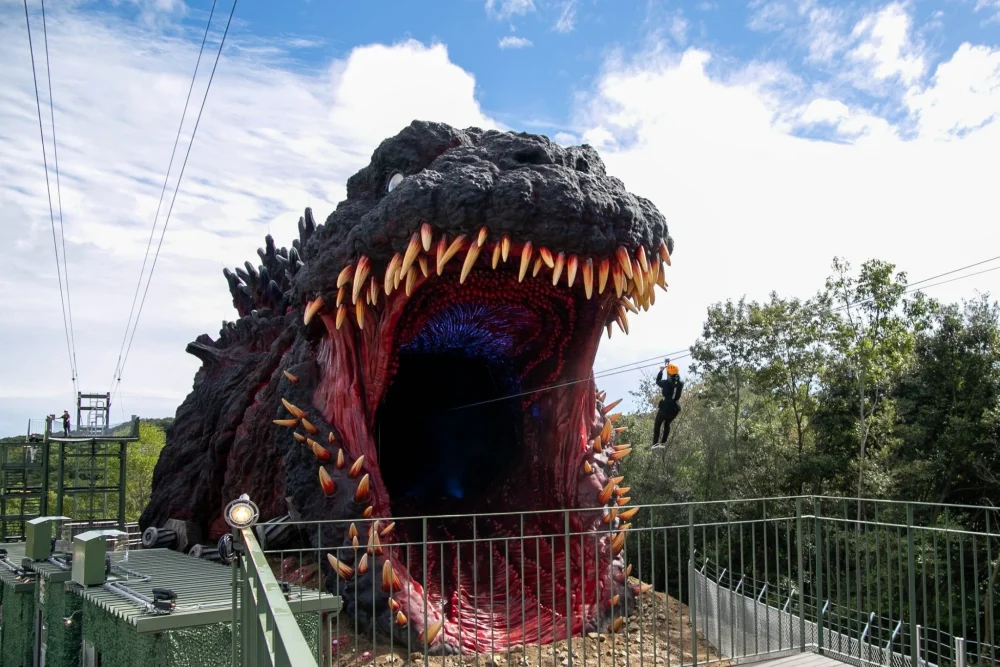
Visitors join the fictional National Awaji-Island Institute of Godzilla Disaster. They are tasked with investigating and neutralizing the threat.
Guests can enter the creature’s body via a zipline through its open jaws or glide alongside it on an external course. The attraction combines adrenaline with theatrical storytelling.
It also houses the world’s first permanent Godzilla museum, reinforcing Awaji’s role as a hub for entertainment and cultural iconography.
Dining and retail experiences, including themed menus and exclusive merchandise, further anchor the attraction within the Nijigen no Mori ecosystem.
Anime and Game Attractions
Equally hands-on is Naruto & Boruto Shinobi-Zato, designed as a physical and mental training ground. It encourages participants to test their agility, observation skills and teamwork, echoing the ethos of the ninja anime itself. Nearby, fans can refuel at Ramen Ichiraku, a faithful recreation of Naruto’s favorite ramen shop, where steaming bowls offer a comforting pause after a day of activity.
Family-Friendly Experiences
The park’s lighter side appears at Crayon Shin-chan Adventure Park, which gives the area a relaxed, family-friendly feel.
It features athletic courses and water ziplines for both kids and adults. The focus is less on spectacle and more on movement and shared fun.
Activities are woven into the surroundings, encouraging visitors to play, explore and enjoy the fresh air instead of queueing for rides.
Video game fans can discover Dragon Quest Island: Zoma and the Archipelago’s Origin, a “field RPG” that seamlessly blends real-world exploration with digital storytelling. Visitors become players navigating a recreated castle town, forests, and the Demon King’s fortress. The experience extends beyond gameplay, with themed dining at Luida’s Bar offering character-inspired dishes that deepen the sense of inhabiting the Dragon Quest universe.
Hello Kitty Smile complements Nijigen no Mori as a waterfront attraction with a softer, more whimsical feel.
Dedicated to one of Japan’s most beloved global icons, the facility blends multimedia art, dining and retail into an experience for all ages.
Set against the Harima Sea, it takes guests through an imagined underwater world inspired by the Dragon Palace of Japanese folklore, brought to life through projection mapping.
The experience ends in Hello Kitty’s room, a popular photo spot where visitors can relax, take pictures and enjoy a quieter moment by the sea.
From Themed Rooms to Quiet Retreats
Where you stay on Awaji Island shapes how you experience it. The island’s main accommodations are closely tied to their surroundings. They use views, food and design to create a strong sense of place, rather than functioning as isolated resorts.
Two of the most distinctive options, Grand Chariot and Senshin Waho, approach hospitality in different ways. They offer contrasting moods suited to different travel styles.
Grand Chariot Experience
Perched at the highest point of Hyogo Prefectural Awaji Island Park, Grand Chariot sits above a 134-hectare expanse of forest and open land.
From the terrace and dining areas, the view stretches toward the Akashi Kaikyo Bridge, the world’s longest suspension bridge. On clear days, Kobe’s skyline glints across the water.
Up here, the air feels noticeably cooler. A mix of sea breeze and forest scent enhances the sense of distance from the city below.
Senshin Waho: A Wellness Retreat
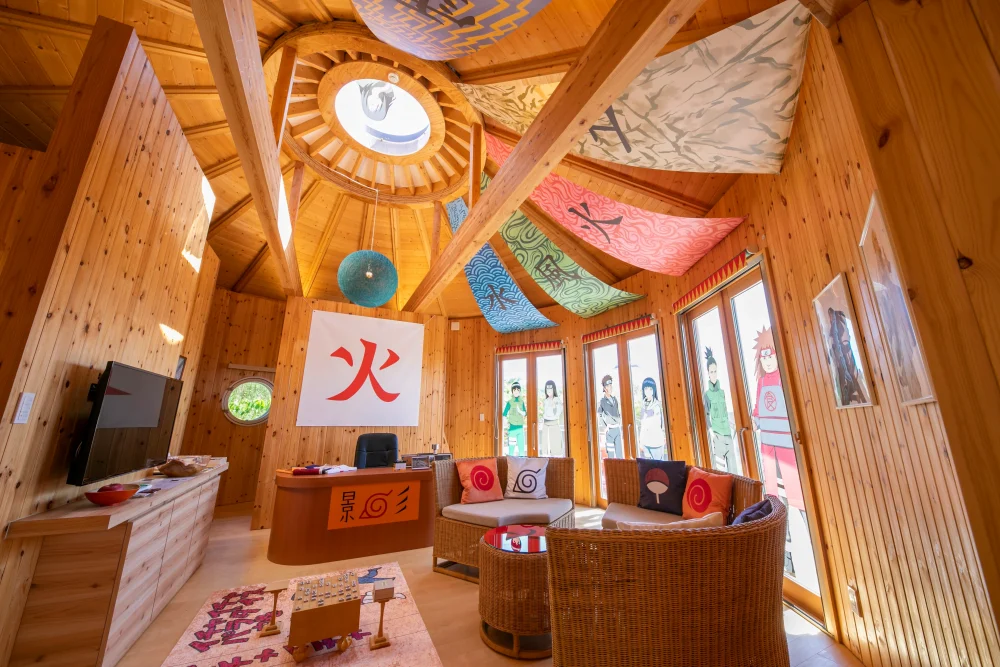
Grand Chariot distinguishes itself by weaving Awaji’s pop-cultural energy into a refined luxury setting. Its themed character rooms invite guests to extend their immersion into the worlds of Nijigen no Mori.
They draw inspiration from Demon Slayer, Godzilla, Crayon Shin-chan, Monster Hunter, Hello Kitty, Naruto and Dragon Quest.
These rooms go beyond novelty. They balance playful imagination with comfort, appealing to families, enthusiasts and travelers seeking a distinctive experience.
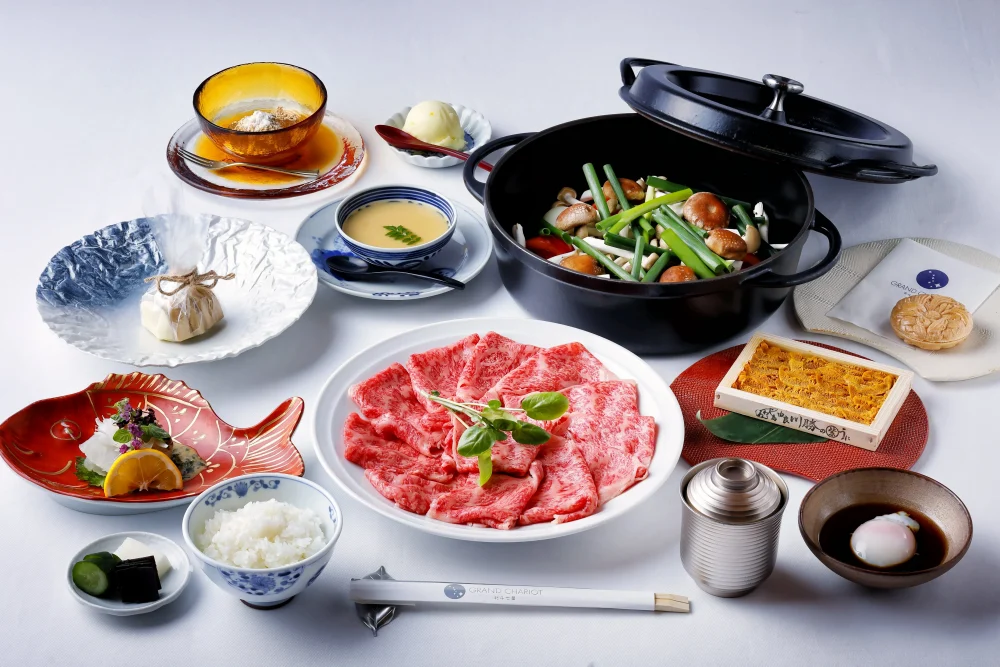
Culinary excellence forms another cornerstone of the Grand Chariot experience. Dining here is overseen by Chef Haruyuki Yamashita, a recipient of the World Gourmet Summit Award, who crafts menus that foreground Awaji Island’s exceptional produce. Guests can enjoy a refined course dinner featuring seasonal ingredients, including indulgent hot pot courses centered on prized Awaji beef. Mornings begin with a beautifully composed assortment of bite-sized dishes that celebrate seasonality and balance, served in a dining room bathed in natural light and framed by expansive views of the surrounding landscape.
If Grand Chariot represents elevated indulgence, Senshin Waho offers a more introspective form of luxury, rooted in wellness and tradition. Conceived as a modern Japanese retreat, Senshin Waho invites guests to slow down and engage with Awaji Island’s natural rhythms. The facility blends contemporary comfort with time-honored aesthetics, creating an environment where physical rest and mental clarity are equally prioritized.
Design and Atmosphere
At the heart of Senshin Waho is its serene Japanese garden, a contemplative space that reflects the principles of traditional landscape design. This atmosphere of calm extends to the natural hot springs, where free-flowing thermal waters gently ease fatigue and tension. The baths prioritize restoration over display, reinforcing wellness as a quiet, deeply personal experience.
Each of the 20 rooms offers ocean views and faces the Japanese garden, creating a continuous visual dialogue between interior and exterior. Guests can choose between traditional tatami rooms with open-air hot spring baths and modern Japanese-style rooms defined by warm wood tones and understated design. In every case, the emphasis is on harmony between architecture and nature, comfort and restraint.
Cuisine at Senshin Waho further reinforces this philosophy. Under the supervision of Chef Fushiki, a specialist in ancient Japanese fermented food culture, meals highlight subtle flavors and textures. Served at a leisurely pace, the food invites contemplation, savoring taste, smell, and listening to one’s body, particularly when tasting the light smokiness of the fish, the deep umami of the fermented vegetables or the way a dish evolves slightly as it cools.
Zenbo Seinei and Mindful Living
Zenbo Seinei completes this vision of restorative hospitality as a Zen wellness retreat focused on introspection rather than indulgence.
Designed by Pritzker Prize–winning architect Shigeru Ban, the facility stretches along a 100-meter wooden deck above the treetops. It offers a rare 360-degree view of Awaji Island’s landscape.
Built from Japanese cedar and recognized with multiple design awards, Zenbo Seinei invites guests to step barefoot into a space where architecture, nature and stillness meet.
Guests can take part in Zen meditation, calligraphy, yoga and mindfulness practices. These are paired with gentle, plant-based cuisine, including rice porridge, tofu and seasonal dishes designed to restore balance.
By day, the retreat overlooks changing skies. At night, it opens to a star-filled landscape. It encourages guests to slow down, listen and reconnect with the rhythms of nature.
From Field to Table
Across the island, restaurants and retail spaces bring together landscape, design and local production, inviting visitors to engage directly with Awaji’s agricultural and maritime heritage.
Oh-SOBAR and Modern Dining
Set against the calm expanse of the Seto Inland Sea, Oh-SOBAR offers one of the island’s most refined culinary experiences. The restaurant pairs contemporary soba cuisine with uninterrupted sea views and the gentle rhythm of waves, culminating in sunsets recognized among Japan’s Top 100. Designed by Yasumichi Morita, the interior balances understated elegance with architectural clarity, framing both the food and the surrounding seascape as equal protagonists.
Oh-SOBAR reinterprets the tradition of soba with a modern sensibility rooted in nourishment and seasonality. Alongside classic 2:8 soba (80% buckwheat flour and 20% wheat flour), the menu features variations infused with nutrient-rich akamoku seaweed and mineral-dense chomeiso herb, offering subtle yet distinctive flavors. The experience is further elevated by thoughtful pairings with local Awaji sake, aged varieties, and sparkling sake, each chosen to complement the island’s produce and the soba’s delicate aromas.
Farm-to-Table at Haru San San
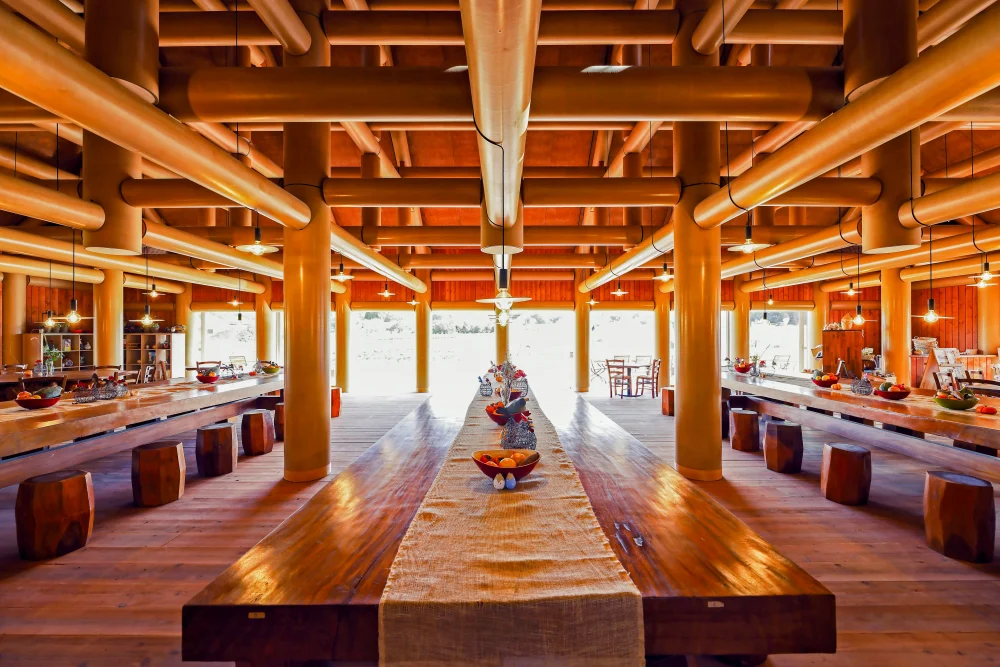
A more pastoral approach to dining awaits at Farmers Restaurant Haru San San, where the emphasis shifts from refinement to sustainability and connection with the land. Shigeru Ban also designed the restaurant, placing it within a lush agricultural setting. He built the structure with environmentally conscious materials and topped it with a thatched roof that naturally returns to the earth.
The architecture itself becomes a quiet statement about circularity and respect for nature.
Haru San San’s menu is vegetable-forward and resolutely local, drawing from produce harvested in the surrounding fields and from Awaji’s wider farming community. The adjacent market extends this philosophy, offering seasonal vegetables and island specialties for visitors to take home.On-site workshops invite guests to engage with farming practices and reflect on how nature’s rhythms shape daily life, turning a meal into an educational and reflective experience.
Craft Circus and Seaside Markets
For a livelier, resort-like atmosphere, Craft Circus brings together dining, shopping and seaside leisure in a single open setting. Overlooking the sea and one of Japan’s celebrated sunset views, the complex unfolds as a playful marketplace divided into distinct yet interconnected zones. At Kaiou Ichiba, seafood is prepared directly from on-site fish tanks, offering casual bowls and barbecues centered on freshness. Craft Kitchen serves generous dishes such as island pizza, Awaji beef burgers and paella, best enjoyed from the ocean-facing terrace.
Beyond dining, Craft Marché highlights Awaji’s agricultural identity through carefully curated products: vegetables from local farmers, onion-based specialties and artisanal seasonings from across the Seto Inland Sea. Nearby, GLOBAL MARKET broadens the horizon further, presenting handcrafted goods and traditional items sourced from Japan and countries as varied as France, Italy, Vietnam, Sweden and Thailand. Even leisure extends to all family members at the Dog Terrace, a dog-friendly café with ocean views, a dedicated pet menu, and an expansive dog run.
An Evolving Experience
Taken together, Awaji Island’s attractions, places to stay, restaurants and small businesses suggest an ongoing experiment. Entertainment may be what first brings visitors across the bridge, but it is the slower layers (eating, walking, relaxing) that shape the experience over time.
Easy to reach by express bus from Osaka and Kobe, with shuttle routes linking major sites, Awaji functions today as both a getaway and a work in progress. Ideas about food, wellness, design, and daily life are being tested side by side, not always seamlessly, but with clear intent. Rather than offering a polished blueprint for life beyond Japan’s major cities, the island invites visitors to observe a place in motion, one that is still evolving, still experimenting, and interesting precisely because the outcome is not yet fixed.
Check out our article on the best of Okinawa’s regional and traditional food.