January 29, 2026
What Is Japanese Tradition?
Should Japan stay “traditional”?
The Oxford Dictionary defines tradition as “a belief, custom or way of doing something that has existed for a long time among a particular group of people.”
The word tradition evokes beauty and continuity, something profound. Yet it also stirs some hesitation in me. In recent years, the rise of reactionary politics, whether in Japan or elsewhere, has often drawn on the notion of tradition to justify exclusion or to silence discussions of meaningful change. Phrases such as “protecting Japanese tradition” have become euphemisms for excluding queer people and immigrants. It has become a loaded term.
You might also like our article, “Is Communication the Way Out of ‘Xenophobia’ in Japan?”
The Myth of a Timeless, Traditional Japan
Outside Japan, the country is often framed, and at times fetishized, as a traditional place—oh so ancient, deeply cultural and faintly mysterious. On the other hand, nations such as the United States are frequently described as less traditional and therefore “cultureless,” which is simply wrong. Japan itself has also leaned heavily on this Orientalist idea of tradition, a notion internalized over the past decades.
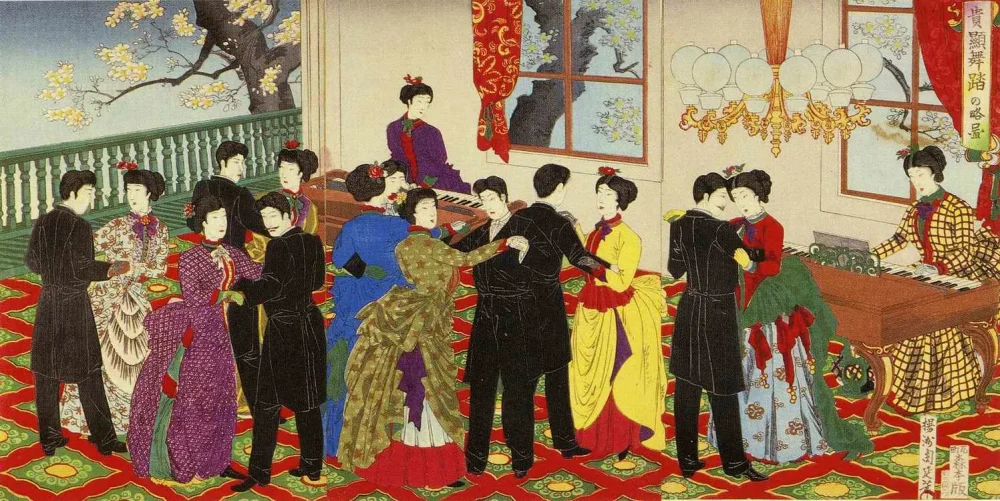
Yet Japanese history tells a different story. Japan is a nation that has repeatedly undergone radical reform and absorbed foreign influences at every stage—an act that is anything but conservative, driven instead by change. Much of what we now see as ordinary, such as the food we eat, the clothes we wear and the architecture we live among, would have been almost unrecognizable a century ago.
Even as a nation-state, Japan has undergone several transformations in a span shorter than the history of the United States. From a samurai-led government to an emperor-centered nation, and then to a parliamentary democracy, the Japan we know today is less than a hundred years old.
Tradition Through Exchange, Not Isolation
From the early continental influence of China and large migration from the Korean Peninsula, to trade with Southeast Asia, to Portuguese and Dutch contact, and later the absorption of Western culture and Japan’s own colonial ventures, the country’s millennium of history shows that its traditions emerged not through isolation but through interaction.
Acknowledging these influences does not undermine their originality or uniqueness. In fact, most of the world’s cultural traditions are traceable back to some interaction among different groups of people. Whether that is British tea, Italian coffee, German beer or French red wine. All come from a larger Asian influence: tea from China and others from West Asia; coffee from the Arabian Peninsula (possibly, via Northern Africa), beer from Mesopotamia, wine from the Caucasus.
Despite traceable histories to other regions, their significance as the traditions of each area in Europe is not contested. Traditions are not exclusionary and are not validated only through isolation.
Every tradition began somewhere
A traditional dish, festival or style of dress was once new. Even if gradual, change was constantly happening. That is why we can define a style of architecture in the Edo period, versus the Heian period, and then, of course, the Meiji era. There was a first time for that first festival, which we now consider the oldest.
If tradition is “the transmission of customs or beliefs from generation to generation,” then transmission itself involves adaptation. Like diasporic communities that carry European traditions into the United States, you can’t confine tradition to geography. Not to mention Japan’s imperialist era, when its “traditions” were imposed upon Asian and Pacific Island cultures. If traditions can only be “protected” by rejecting immigration, upholding patriarchy or denying minority rights, we must ask whether that protection serves tradition at all, or whether such traditions should simply be remembered as history, preserved in our memory or in museums.
Tradition is an essential part of culture, but culture also means coexistence between continuity and change. Tradition is not static; it evolves as generations pass it down, and new traditions are always forming. Before we speak of what is traditional, we should reflect on what we mean by tradition. And resist using the word as a tool of exclusion or a false logic of isolationism. What history makes clear is that Japan’s tradition lies not in resisting change, but in its flexible interpretation of diverse influences. It is the balance of preserving and inventing that creates the kind of tradition that lasts.
Also check out our article on Japan’s Unwritten Rule of Space and how it shapes Japanese tradition.