March 25, 2010
Caught on Film
Nikkatsu revives one of the most successful movie genres of the ’70s and ’80s: roman porno
By Metropolis
Originally published on metropolis.co.jp on March 2010

All images courtesy of Nikkatsu
The promotional flyer says it all: “This is not a remake—it’s a return!”
Four decades ago, struggling movie studio Nikkatsu shifted its focus from action and gangster films to a form of soft pornography termed roman porno (a combination of the English words “romance” and “pornography”). It was a breakthrough genre for a major studio: hour-long films with relatively substantial storylines blended with copious nude scenes.
The first roman porno to be released, 1971’s Danchizuma: Hirusagari no Joji (“Apartment Wife: Afternoon Affair”), detailed the erotic extramarital activities of a housewife residing in one of Japan’s infamously bland suburban block-housing units.
“At that time, society regarded it as a dirty film,” said the female lead, Kazuko Shirakawa, 62, during an appearance at Eurospace theater in Shibuya last month. “It was not ordinary for a woman to be seen naked. The overall content was a bit shocking.”
Yet the audiences applauded, and the studio had a hit on its hands, with Shirakawa reaching certifiable “queen” status. Apartment Wife went on to generate 20 sequels, and by the end of the genre’s run 17 years later, a stunning 1,100 roman porno features had been released.

Nikkatsu, Japan’s longest-running studio, is now making a comeback with reworked versions of the genre’s seminal films. Under the moniker “Roman Porno Returns,” the series has revitalized a cultural icon that launched the careers of many stars of the conventional film industry.
Updates of both “Apartment Wife: Afternoon Affair” and 1980’s Ushiro Kara Mae Kara (“From the Back, From the Front”) recently enjoyed two-week runs at Eurospace. The two are now playing in Sapporo and will move to Osaka and Fukuoka next month. Satellite provider Sky PerfecTV!, meanwhile, airs From the Back on a pay-per-view basis.
“At first I was shocked about the revival because these films represented my youth,” said Shirakawa. “But then, after realizing that one of the original directors was involved, I had total confidence.”
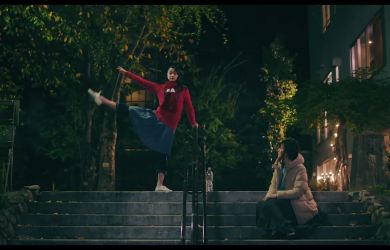
That director is 58-year-old Shun Nakahara, who helmed the 75-minute remake of “Apartment Wife,” in which Sayaka (Sakiko Takao) has a series of erotic encounters with a water-purifier salesman (Masaki Miura).
Shirakawa, who appears in a cameo role, feels that the revival gently conveys the simple life of this plain housewife, a woman who “has something inside her uterus that is screaming to get out.”
“The director beautifully uses symbolism to describe this feeling welling inside her,” she said, “such as with the scenes showing running tap water and boiling pasta noodles.”
Nikkatsu sees the roman porno revival as an opportunity for emerging filmmakers and actors to make their mark. Over the last few years, Japan’s box office has been dominated by TV network-produced films, which are staffed by their own production crews—a trend that many in the industry believe is shutting out new directors.
“It is hard for young talent to make a debut,” says Yoshinori Chiba, a producer of the new films. “We are hoping that the ‘Returns’ series will bring opportunities to young directors to break through this closed environment.”
The reworking of From the Back, a rather nasty comedy directed by fresh face Shoichiro Masumoto, finds sultry and shapely taxi driver Momoko (Tomomi Miyauchi, a former model and member of the Miniskirt Police pop group) offering passengers far more than a simple ride when they hop in her back seat.
Shirakawa’s roots in the trade go back to the ’60s, when she was performing in pinku eiga, a similar genre in which tiny, independently run studios churned out quick-and-dirty erotic productions.
With little in the way of a support staff, Shirakawa said that a pink actress was relegated to such menial tasks as fixing her own hair or purchasing a kimono at a pawn shop. “I really learned how to read the script because there was nobody there to assist me,” she said. “I became a self-made person.”

By contrast, Nikkatsu’s roman porno films were able to offer larger budgets and, as a result, better production values. They also benefited from distribution via the studio’s chain of theaters. Shirakawa recalls that after being lured away from pinku eiga by Nikkatsu, she felt like she had taken a definite step up.
“When I was in pink films, I had to hide my job and couldn’t make aspects of it public,” she said. “On the cover of the scripts, I had to write something like ‘Fuji TV’ to conceal the contents. However, at Nikkatsu, I felt as if I was in Hollywood.”
Director Nakahara said that he was initially reluctant to join Nikkatsu because the studio had “stolen” Shirakawa, his favorite erotic actress, whom he frequently caught on pink screens when he was a student. “But once I saw a roman porno film, I was reminded of a new wave of American cinema,” said the director, who made his debut in 1982 with Okasare Shigan (“Candidate for Seduction”).
Roman porno got its start during an era when the emergence of television threatened the entire film industry; Nikkatsu, for one, was on the verge of bankruptcy. In Japan’s “Golden Era” of cinema in the ’50s and ’60s, the number of screens around the country totaled over 7,000, but by 1970 only 3,000 were left.
“The roman porno direction was taken to rebuild the company,” says Nikkatsu’s Chiba.
Although Shirakawa may be correct that Apartment Wife was shocking for its content, major studios in Japan previously dabbled in smutty offerings. Along with Toei, which in the ’60s experimented with various torture and erotic-grotesque films, Nikkatsu had released its share of non-puritanical fare, like director Seijun Suzuki’s Nikutai no Mon (“Gate of Flesh,” 1964). As with today’s revival, the emergence of the roman porno genre provided a testing ground for young talent to develop their craft—that is, as long as the requisite skin-scene-every-ten-minutes quota was met.
“It had the image of something new, something different,” said Nakahara. “All of the directors were competing to come up with something novel. If one director did one thing, another would try something else.”
The styles went far beyond the bored-housewife standard, taking in everything from hardcore SM, like 1974’s Hana to Hebi (“Flower and Snake”), to truly romantic stories, like the very soft Love Letter (1981), which was billed as appropriate for female audiences. According to the “Roman Porno Returns” website, students would look forward to the release of two new films every other week, and the competition between directors resulted in quality productions. The movies were intended to be genuinely emotion-filled—a contrast to typical porn flicks that focused on naked bodies and pounding flesh.
“Roman porno was not trying to simply show sex. It also wanted to bring adult themes out into the open,” says Jasper Sharp, author of the book Behind the Pink Curtain (2008), a look at the history of sex in Japanese cinema.
Critical acclaim was not unusual. In 1972, trade magazine Kinema Junpo ranked Ichijo Sayuri: Nureta Yokujo (“Ichijo’s Wet Lust”) eighth in its annual top ten list, and in 1999 named it one of the top 100 Japanese films of the century.

Predictably, the high profile of roman porno stirred up controversy, most notably involving the original “From the Back, From the Front,” which starred singer Yoko Hatakenaka. A one-time idol, she was featured on NHK’s year-end Kohaku Uta Gassen in 1978. A single titled “From the Back, From the Front” was released two years later, around the same time as her roman porno debut in “Ai no Hakujitsumu” (Daydream Love), a controversial transition that propelled the song and subsequently the film, released that December, to hit levels.
Roman porno finally died out in the ’80s, largely due to the emergence of adult video, which allowed fans to get their fill of erotica in the privacy of their own homes. In 1993, Nikkatsu filed for structural reorganization, and the studio, originally founded in 1912, is now jointly owned by SKY PerfecTV! and the Nippon Television Network. In true Nikkatsu fashion, the studio last year launched a special imprint specializing in gore films, Sushi Typhoon, which producer Chiba is heading.
Critics believe that the original roman porno films laid the foundation for much of today’s Japanese cinema. Time Escapade: 5 Seconds Before Climax (1986) is included in the resume of director Yojiro Takita, who won an Oscar in 2009 for Okuribito (“Departures”). Nakahara went on to make the critically acclaimed mainstream feature Sakura no Sono (“Cherry Blossom Garden”), a 1990 adaptation of a manga set in a high school.
The original roman porno movies are not entirely dead, either. Film festivals around the world, especially in France, routinely slot the productions into their lineups, and revival theaters in Tokyo often have their own screenings. Cinema Vera in Shibuya (www.cinemavera.com) is now featuring numerous works by roman porno directors like the acclaimed Noburo Tanaka, including 1977’s SM-themed Hakkinbon Bijin Ranbu Yori: Semeru! (“Beauty’s Exotic Dance—Torture!”).
Although Nikkatsu has no current plans to continue the revival series, the positive response it has received from filmgoers—many of them female—has been overwhelming. The studio is now contemplating further releases.
“Perhaps people are fed up with the information on sex that is chaotically floating around the world,” says Chiba. “We hope that ‘Returns’ will establish itself as a new genre that will assimilate itself into the present era.”