July 6, 2025
Japan: The White Man’s Last Refuge?
Are Japan's 'White Gods' enjoying the benefits of "sexist" cultures abroad?
Across many countries, including Japan, there is somewhat of a mass call for reparations occurring. Movements such as #metoo or #neverthelessshepersisted are forcing men to reflect deeply on how they have taken advantage of the status quo. This, I believe, is an unconscious act on the part of men, similar to the manner in which most Western people have unconsciously taken advantage of a systemically racist social structure. Nonetheless, the impact is there and women are making history as they come forward in mass numbers, empowered, to testify about moments in which they were disrespected, discriminated against, or abused either psychologically or physically for being a woman.
Many of the darker sides of Japanese society discussed in the media concern issues related to the treatment of women. While both the Japanese media and the public have begun to address these problems more openly in recent decades, progress remains limited.There is clear evidence of a systematic refusal to recognize this vast inequality in the case of Shiori Ito. Many women, myself included, have felt at one point or other that we must entertain the ‘silly’ comments or come-ons of men because they’re men, and that’s how they are: “Are you sure they’re not just joking around?” or “You should really take it as a compliment.” Yet the same voices tell us we must wear stockings with skirts or dresses despite the summer heat. In many circles of this society traditional male and female roles are still upheld. We foreigners living here all struggle to find our places within these boundaries, to fit into this society.
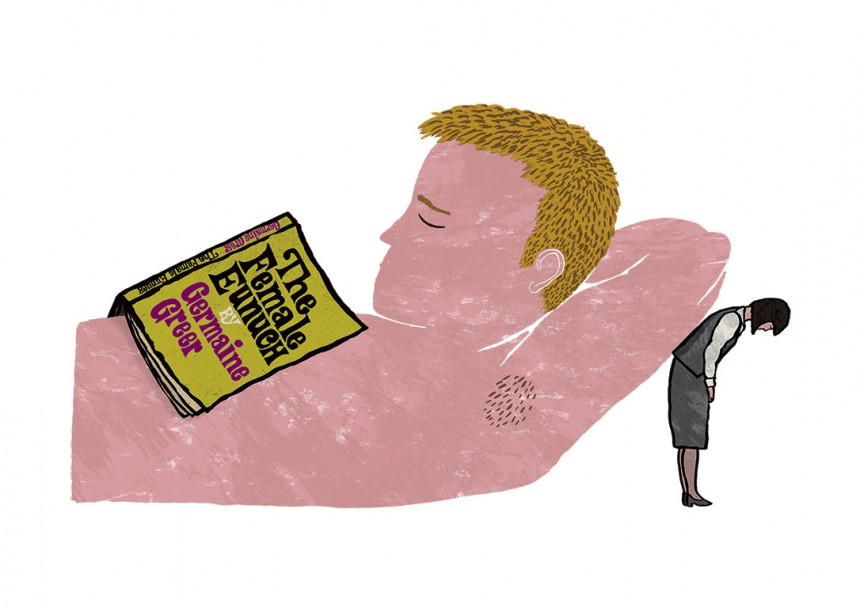
But I’m rather tired of coming across Western men, usually married to Japanese women, who have somehow in this modern day and age been too oblivious — or ‘too busy’ — to notice that their compatriots are being challenged to change… to grow… in their home countries. The two quotes above were said to me by Western men defending other men. In this society, more than anywhere else, we need the voices of men to speak out and support the women who are putting themselves in very vulnerable positions trying to initiate change. Many of us have noticed the opposite is occurring, and there are some logical reasons I believe some of you are falling behind.
What’s more ironic is that, in recent years, Japanese men themselves are being pushed to reflect more deeply on gender issues, as public debate grows and young generations question old hierarchies. In many cases, it’s not Japanese men clinging to the past—but some of you, who come here seeking a nostalgic fantasy of gender relations that no longer exists back home.
In the Japanese workplace, despite the large number of women now working, gender roles remain in place — especially at management level. Perhaps you ignore (or even chime in) when your male colleagues ‘suggest’ to women that they would be so much better at a particular assignment because they’re a woman, or when your boss scolds a female for wearing too much, or not enough, makeup. What you’re actually doing is reinforcing this damaging stereotype; a faceless cog in a broken down car blocking a highway. There are endless examples of women being made to feel that they are simply worth less than men. If you are a white man in a position of power it is your responsibility to both recognise this and actively work to change it.
“But why?” You ask. Life is good. You appreciate the fact that you’re far away from all of that hysterical “political correctness”. Why stir the pot? The fact that complaints in this society are not as loud as those in the West is not a reflection of your behaviour … but demonstrates just how much women have learned to tolerate.
Many of you praise Japan as if it were a refuge untouched by “wokeness.” But this is a fantasy—born not from reality, but from distance. Most of those who say so cannot read Japanese well enough to follow the local news, nor are they in touch with the country’s vibrant media and online conversations where feminism, LGBTQ+ rights, and power dynamics are debated every day. The Japan you imagine—a haven of polite, obedient women and rigidly defined roles—exists more in your mind than in daily life.
Finally, this applies to all humans: it is easy to avoid change. We’re observers of another culture here. We are looking outwards, and often we are reflecting only in terms of comparison to another culture. These are changes that we can usually make without admitting we were doing something badly before, just differently. Growth is hard because it requires the admission that we have previously done something that was somewhat wrong. It takes a certain amount of humility and grit to grow.
You may choose to continue living your life here as though an aspect of your identity isn’t under attack for valid reasons. Ironically, it is your own culture you will be obnoxiously ignoring, much as the White God does upon arrival in Asia. You may choose to view Japan as the last refuge of this particularly obtuse White Man. But I have more faith in you. I think you actually want to make yourself better when an opportunity presents itself. Will you take this one?