February 5, 2026
The Best Japanese Films for Beginners Learning Japanese
Why children’s stories and quiet domestic life work better than reading textbooks will
Learning Japanese at the beginning can feel oddly hostile. Conversations seem to skate around meaning instead of landing on it, sentences trail off, feelings are implied rather than stated…
Even when you recognize individual words, the intent might slip past you. For a beginner, that ambiguity can make the language feel impenetrable.
Although anime is popular among language learners, much of its dialogue is heightened, theatrical, or genre-specific, meaning it rarely mirrors the rhythms and word choices of everyday Japanese conversation you’ll hear and use in reality.
The films that help most at this stage are the ones where characters talk “normally” and have no reason to hide what they mean. Think children’s stories, stories rooted in the real world and quiet domestic dramas. This list of films has Japanese that is emotionally direct, rhythmically clear and rooted in everyday experience. They do not simplify language for learners, but they remove the social layers and fantasy that usually obscure it, so you finally have a way in to begin learning through movies.
You can also practice your Japanese listening skills with these 7 Japanese Romance Movies that will surely tug at your heartstrings.
My Neighbor Totoro
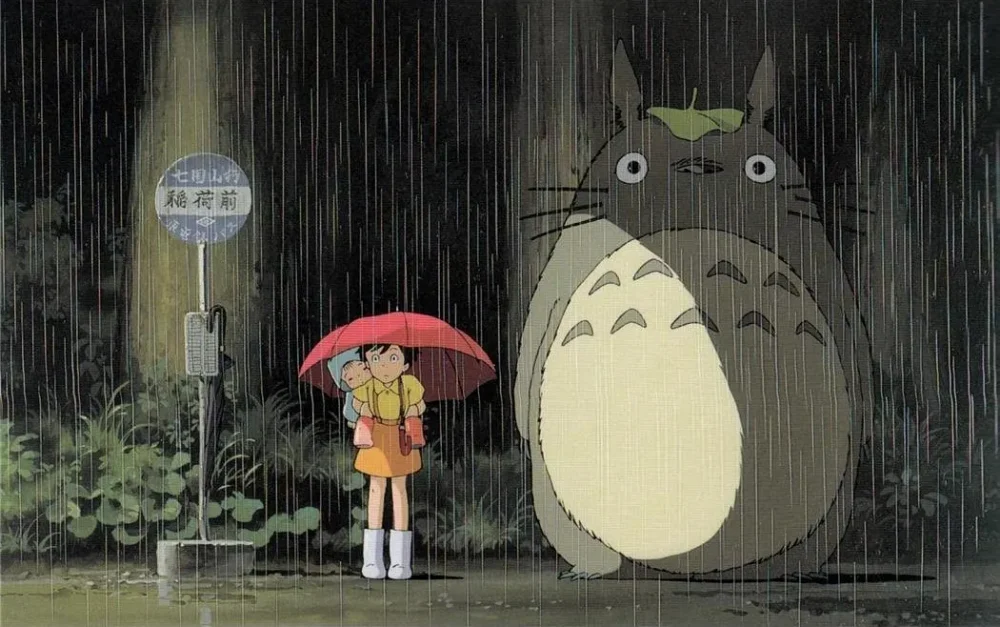
There may be no better starting point for listening to Japanese than My Neighbor Totoro. Not because it is animated, but because it centers on children and children speak plainly. They name what they feel and ask questions directly and the adults around them respond in a simple way that the kids will comprehend.
This was the first film I ever watched without subtitles and the language here is pretty deliberate, built from short sentences and familiar vocabulary. You hear the same expressions for fear, excitement, hunger and reassurance again and again, each time anchored to a clear emotional context. For beginners, this creates something invaluable: confidence. You are not guessing what is being said, but you are hearing Japanese attach itself to meaning in real time.
Kiki’s Delivery Service
Kiki’s Delivery Service works for a slightly different reason. Kiki is older, more eloquent and constantly navigating interactions with adults. Because she is inexperienced and unsure of herself, she has to explain what she wants, apologize when things go wrong and ask for help directly.
The result is Japanese that remains natural and polite but uncomplicated, full of everyday phrases that repeat naturally throughout the film. Conversations move at a regular pace and characters allow space between lines.
Ponyo
Where Totoro teaches basics and Kiki teaches polite structure, Ponyo teaches repetition. Much of the dialogue is intentionally simple, built around a very small set of words that recur constantly since our protagonist is, well, only a young fish.
Hearing the same verbs, emotions and reactions repeated across different scenes allows your brain to relax into the sound of Japanese rather than strain against it. The story carries you forward even when your comprehension lags, which is exactly what beginners need in order to build listening stamina. It’s easy to follow the plot and the visuals are pretty even if you get lost with the words.
Stand by Me Doraemon
Doraemon films are designed so that children understand the emotional stakes at all times and that clarity carries over into the language. Characters explain their feelings out loud. Problems are stated clearly. Adults speak gently and directly, while children articulate frustration, jealousy and hope without much filtering.
For learners, this explicitness is invaluable. Japanese often relies on implication, but Stand by Me Doraemon makes sure nothing important goes unsaid. You hear family Japanese, school Japanese and problem-solving language delivered at a pace that feels generous rather than overwhelming.
Crayon Shin-chan: Arashi o Yobu Appare! Sengoku Daikassen
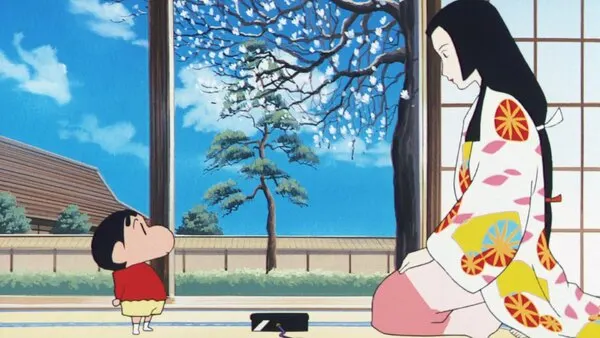
Among the many Shin-chan films, Sengoku Daikassen stands out as particularly useful for beginners. Shin-chan’s speech is famously blunt and playful. He says exactly what he thinks, exactly when he thinks it, with no concern for politeness or subtlety. And he peppers his speech with repeated catchphrases and sounds.
Although the story involves time travel to the Sengoku period, the language never becomes inaccessible. Shin-chan’s modern, simplistic speech contrasts sharply with the serious setting, making intentions and emotions easy to track. Adults frequently explain situations out loud, and the film’s tear-jerking emotional weight gives the language resonance without requiring complete comprehension.
Tampopo
Tampopo is not a children’s film, but it works for beginners because it operates on exaggeration rather than nuance. Characters are broad archetypes, and subtlety would undermine the humor. As a result, emotions are spoken plainly and motivations are obvious.
Dialogue is closely tied to action, allowing you to understand scenes even when individual words escape you. For early learners, this kind of clear cause-and-effect relationship between speech and situation is far more helpful than intricate psychological realism.
Kamome Diner
At the opposite end of the spectrum is Kamome Diner, a quiet film where very little is said, but what is said is careful and precise. Characters speak slowly, often using polite forms and short sentences, with long pauses in between.
Those pauses give beginners time to process without breaking immersion. Rather than overwhelming you with dialogue, the film allows meaning to settle naturally. It reflects the kind of Japanese used when people are being thoughtful and considerate, rather than clever or evasive. It’s tougher to follow than the children’s films on this list, but slow enough that it’s not overwhelming with walls of dialogue.
How to Study Japanese by Watching Movies
1. Watch once with English subtitles to understand the story.
2. Watch again with Japanese subtitles,
3. Then choose a single scene and return to it.
4. Pause whenever you need to Google something, but don’t go too long down one rabbit hole, let the film keep its momentum.
5. Listen for repetition rather than new vocabulary, and focus on who wants what and how they feel.
6. Finally, focus on vocabulary that you hear repeated, as these words are now easier to stick in your memory.
Getting into Japanese literature? Here are 10 Must-Read Japanese Novels Set for Release in 2026.