Wild Roots: A tour of Japan’s forests
A guide to Japan’s forests, from Hokkaido’s taiga to Okinawa’s jungle, with ancient beech, sacred cedar and rare wildlife.
Two-thirds of Japan is trees, and the country is actually one of the most forested on Earth. It’s a figure that puts this supposedly hyper-urban nation shoulder to shoulder with Finland and comfortably ahead of Brazil.
You could drop the entire population of Tokyo into the woods of a single prefecture and have a hard time finding them. The cities are a real attraction, but they are a bright rind on a very deep, very old, very green fruit.
What follows is a walk down the length of that green—from the drift ice of the far north to the coral-warm forests of the subtropical south.
Bring good boots. It rains a lot.
The North — Hokkaido
Where the forest still has teeth
Start at the top, in Hokkaido, because Hokkaido is where Japan stops being polite. Here, the forest is taiga—the same cold northern woodland that rings the top of the whole planet. And it behaves accordingly.
At its heart sits Daisetsuzan, a national park so large it is often called “the roof of Hokkaido,” a sprawl of volcanoes, alpine meadow and conifer bigger than several small countries. Autumn arrives here first, weeks before the rest of Japan. It rolls down the mountainsides in a wave of gold and scarlet. The Ainu, Hokkaido’s indigenous people, called it Kamuy Mintar—”the playground of the gods.”
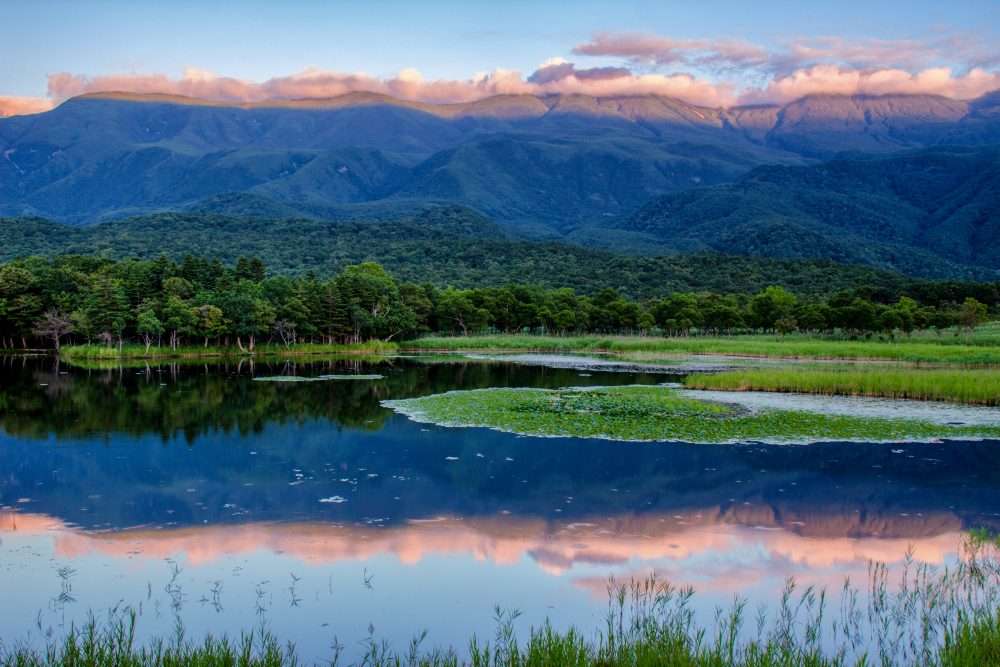
Further east, jutting into the Sea of Okhotsk, is Shiretoko, a peninsula so remote its name means “the end of the earth.” In winter, pack ice drifts down from Siberia and locks the coast in white.
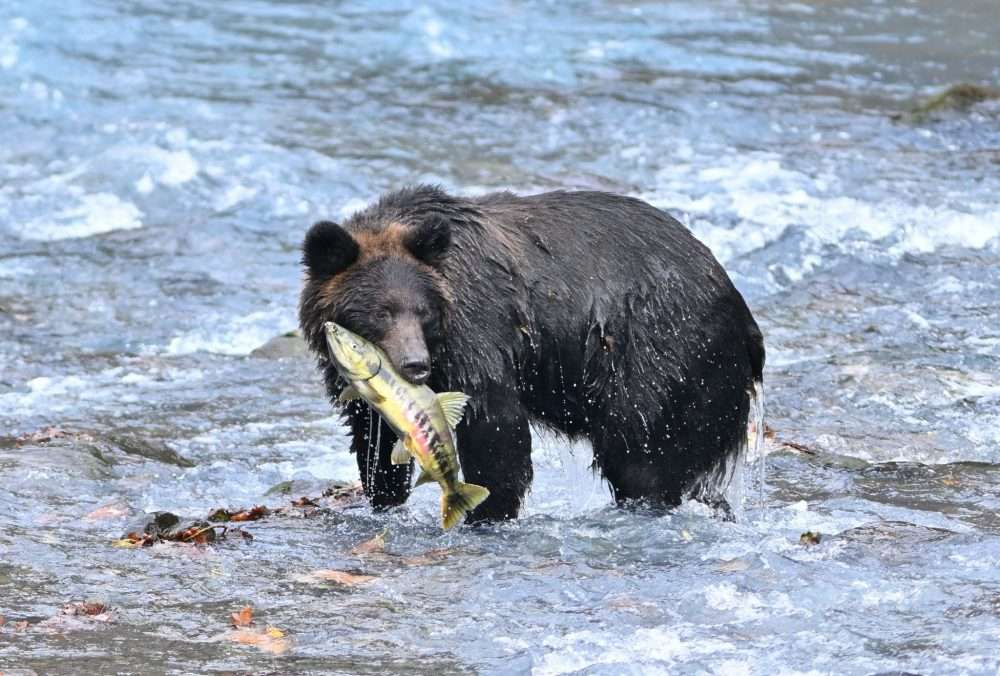
This is one of the last places on the planet where you can watch brown bears fishing for salmon against a backdrop of sea ice. Hokkaido has one of the highest densities of brown bears on Earth. The local higuma can weigh as much as a grand piano.
The star resident is the Blakiston’s fish owl, the largest owl in the world—a nearly two-metre wingspan of feathers that hunts by wading into freezing rivers.
There’s also the naki-usagi, the Japanese pika: a tiny, round-eared relic of the Ice Age that survives only in high, cold boulder fields, squeaking like a squeezed toy. It is, scientifically speaking, one of the most adorable animals alive, and it is quietly running out of cold.
Sakhalin fir and Yezo spruce, dark and spired, give way in autumn to the flaring reds of Erman’s birch and mountain ash. The forest floor, briefly, in July, becomes an alpine rock garden.
THE NORTHEAST — TOHOKU
The last of the ancient beech
Head south to Tohoku, the great rural shoulder of the main island, and the forest changes character entirely—from spired conifer to the round, luminous canopy of beech.
Shirakami-Sanchi, straddling Aomori and Akita, holds the largest surviving stand of virgin Japanese beech forest in all of East Asia. It’s the last unbroken remnant of the woodland that once blanketed the entire cool-temperate belt of northern Japan before the axes came.
In 1993, it became one of Japan’s very first UNESCO World Heritage Sites. Almost no trails cross its core. You are simply not allowed in most of it, which is precisely why it has survived.
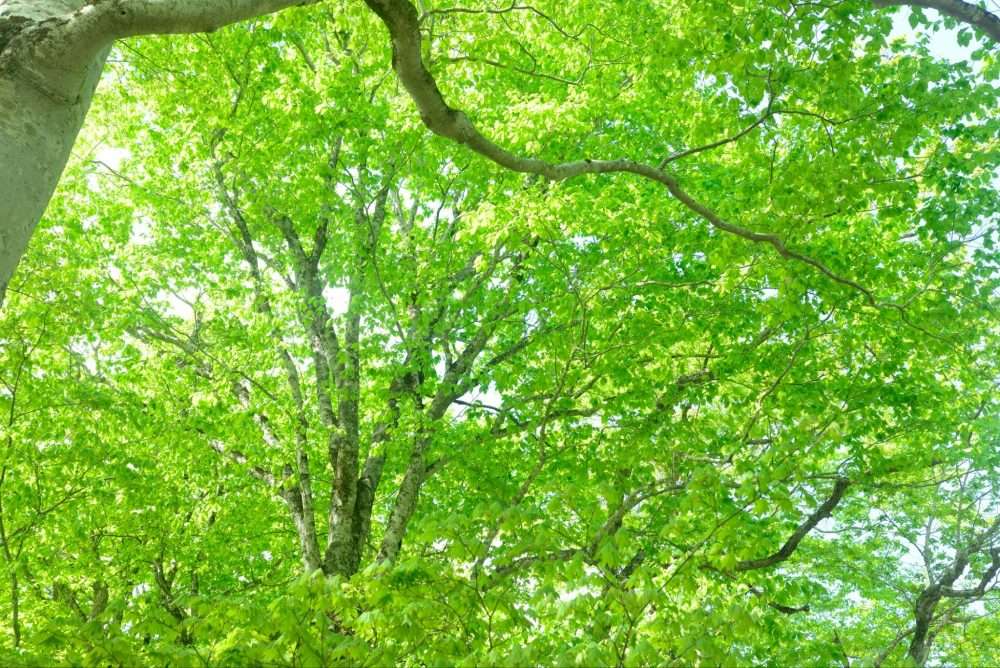
A beech forest is a strange and generous machine. The pale grey trunks hold up a canopy so even and so soft that the light beneath turns the colour of green tea. Beech are champion water-keepers — the spongy leaf litter and mossy floor drink the snowmelt and release it slowly all year, which is why the streams here run clear in the driest August.
Japanese beech is called buna, and foresters once dismissed it as a “useless tree” because its timber rots easily. That contempt is the only reason Shirakami’s giants are still standing. Sometimes worthlessness is a form of protection.
Watch for the kumagera, the black woodpecker—a crow-sized, red-capped bird whose hammering echoes through the trunks like someone knocking to be let in. Overhead, golden eagles. On the slopes, the Japanese serow: a shaggy, goat-antelope thing with a philosopher’s face that will stand and stare at you with total, unbothered calm.
THE CENTRE — HONSHU’S HEARTLAND
Sacred cedar, seas of lava and a forest made of grass
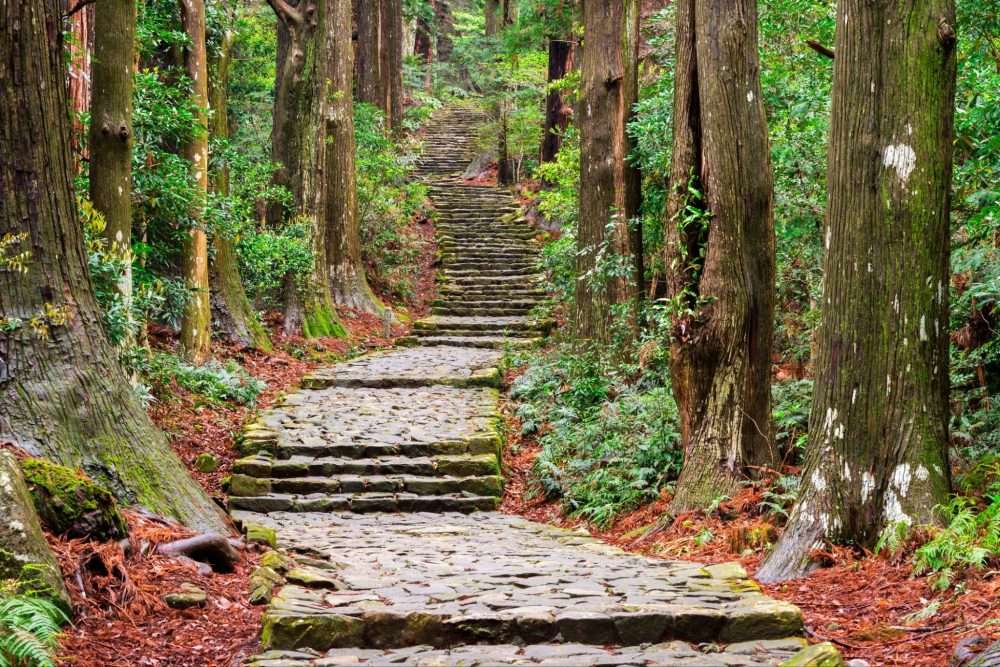
The middle of Japan is where the forest and the culture grow into each other until you can’t tell them apart.
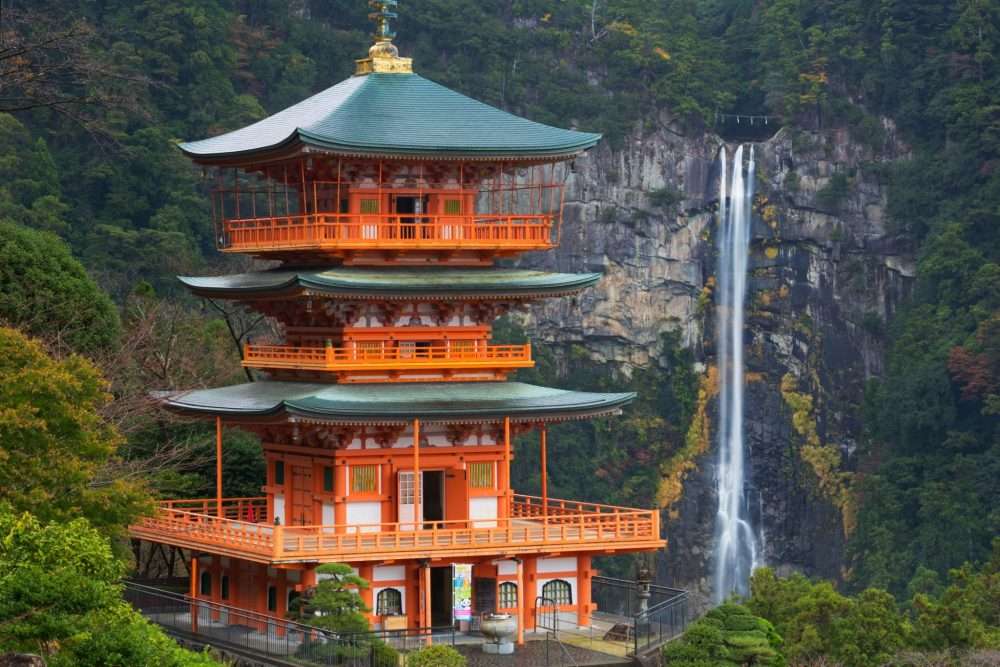
On the Kii Peninsula, south of Osaka, the ancient pilgrimage routes of the Kumano Kodo wind for days through towering plantations of sugi (Japanese cedar) and hinoki (cypress), past moss-furred shrines and the thread of the Nachi Falls, the tallest waterfall in Japan.
People have been walking into these mountains to find the sacred for over a thousand years. The trees here aren’t a backdrop to the religion; they are the religion. Shinto holds that gods, kami, live in especially grand old trees, which is why you’ll find so many wrapped in a sacred rope, the shimenawa, marking them as divine.
Then there is the strange case of Aokigahara, the “Sea of Trees” at the foot of Mount Fuji. In the year 864, Fuji erupted and poured a vast sheet of lava across its northwest flank. The forest that colonized that hardened lava is like nowhere else in Japan: the trees root sideways across bare rock because there is no soil to sink into, their roots twisting over the ground like frozen snakes. The lava is so dense and the canopy so complete that the wind barely enters.
The forest is famous for a deep, almost pressurised silence, and for local pockets of iron-rich rock that can send a compass needle wandering. It carries a sombre modern reputation, but as a piece of raw planetary machinery—a living forest growing on a wound—it is genuinely without equal.
And for something completely different, walk into the Arashiyama Bamboo Grove on the western edge of Kyoto. This is a forest with no trees at all. Moso bamboo is a grass, not a wood, and in spring it is the fastest-growing plant on Earth—capable of shooting up nearly a metre in a single day.
Stand among the green columns and the whole grove creaks and clacks and hisses overhead. The sound of wind moving through the Arashiyama bamboo is officially protected. Japan’s Ministry of the Environment lists it among the “100 Soundscapes of Japan” worth preserving. It’s the only country to have formally catalogued its nation’s best noises.
WORTH NOTING: Japan’s infamous spring hay-fever epidemic—the masks, the streaming eyes of millions every March—is not natural. After World War II, the government planted vast monocultures of sugi cedar to rebuild the country. Those cedars grew up, matured, and now dump biblical quantities of pollen on the population every spring. A national health affliction, planted on purpose, sixty years in advance. The forest, it turns out, remembers what you did to it.
THE FAR SOUTH — YAKUSHIMA & OKINAWA
Rainforests, thousand-year cedars, and a bird that forgot how to fly
Keep going south, past the tip of the main islands, and Japan does its final magic trick: it turns tropical.
The island of Yakushima rises out of the sea off southern Kyushu like a green fist, and it may be the most extraordinary forest in the entire country. It rains here almost past belief—locals joke that it rains “thirty-five days a month.” All that water feeds a temperate rainforest of such saturated, glowing green that the moss alone comes in some six hundred varieties, carpeting every rock, root and fallen log until the whole world looks upholstered.
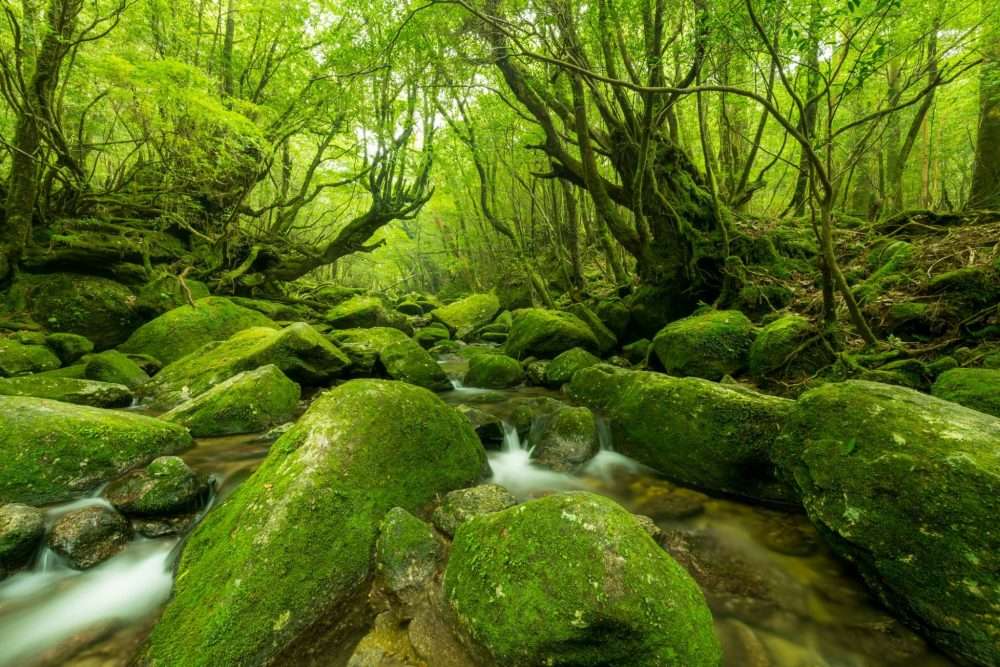
Rising out of that moss are the yakusugi—ancient cedars of almost incomprehensible age. The most famous, Jomon Sugi, is estimated at somewhere between two thousand and seven thousand years old. It was a mature tree before the Pyramids. If you have ever seen the drifting spirit-forest of Studio Ghibli’s Princess Mononoke, you have already seen Yakushima. This is the place that Hayao Miyazaki walked to design it.
On Yakushima, you can pass through nearly every climate zone in Japan on a single mountain. Start in subtropical forest at the coast and climb until you reach snow and near-alpine tundra at the summit. It is the entire archipelago, stacked vertically on one island.
The island has its own subspecies of deer and macaque—the Yaku-shika and Yaku-zaru—both shrunk to smaller sizes by island life, and often seen grooming each other in the mist.
Finally, at the very bottom of the map, lies the subtropical jungle of Yambaru in northern Okinawa. It was only added to the UNESCO World Heritage list in 2021. Here hides one of Japan’s great biological punchlines. The Yambaru kuina, or Okinawa rail, is a plump, red-legged, boldly striped bird found nowhere else on Earth. It was unknown to science until 1981—a brand-new bird, in a wealthy modern nation, discovered within living memory.
And here is the detail that ought to make you love this country’s forests forever: because Yambaru had no ground predators for so long, the Okinawa rail simply gave up flying. It runs. It roosts in trees at night by scrambling up the trunk on foot.
This article was originally published in the Autumn 2026 “Earth” Issue of Metropolis.
Curious about more of Japan’s nature? Check out: