The Art of Japanese Handmade Jewelry
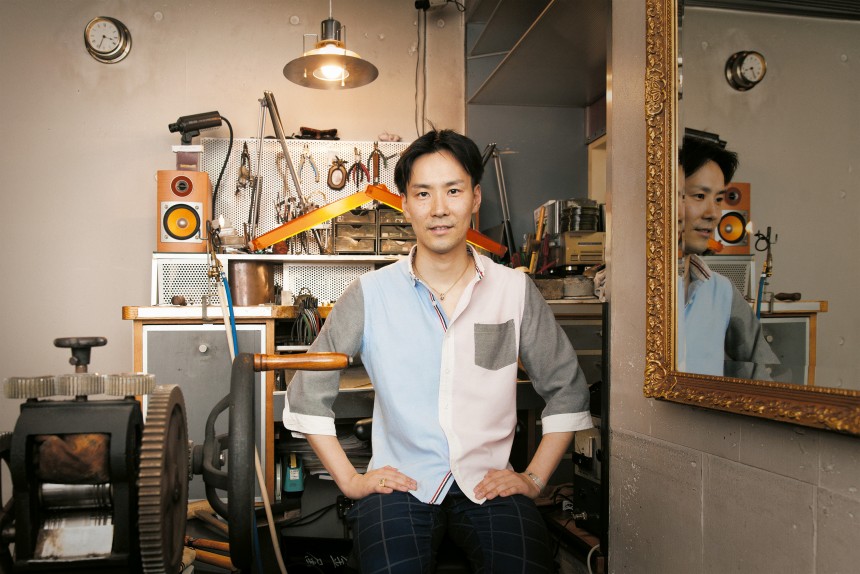
Hayakawa’s beautiful crafts
The Craft Behind Handmade Japanese Jewelry
Handmade Japanese jewelry designer Takuji Hayakawa’s creations are exclusively one-of-a-kind. Hayakawa brings each unique piece—handcrafted upon request — similar to other traditional practices like the art of kodo—to life on his own, though he develops the vision together with the customer through careful discussion. Creating the finished product, which takes no less than a month and begins by melting a lump of metal, is no easy process. But it’s a greatly rewarding one, as Hayakawa hopes to produce timeless Japanese handmade jewelry that people can treasure through generations.
A Family Craft Passed Down Through Generations
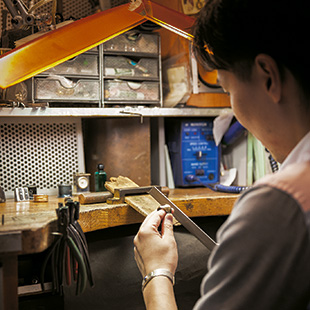
(Photo by Julio Shiiki)
Although once a popular trade during Japan’s prosperous “bubble economy” era, very few custom-made jewelry businesses exist today. Hayakawa learned the craft from his own father, and is the third generation of his family to take up the profession—though he did not set out on this path from the beginning.
There was never any pressure from his parents to follow in their footsteps, either. Hayakawa even worked different jobs before he finally decided to join the family business. It was during a trip to Italy—where many small, family-owned jewelry businesses still exist—that he discovered the beauty of the vocation.
Although jewelry design, Hayakawa explains, doesn’t require specific qualifications like those needed to become a doctor or a lawyer, it can be difficult to master without the proper equipment, or a shop in which to display and sell products.
In this regard, Hayakawa was lucky, as his family’s shop, Shinku’S, provided him with the necessary environment in which to
begin. Now that he’s been creating jewelry for some time, having been at the shop’s Roppongi location for over 20 years, Hayakawa feels that the job is quite fitting. Interacting with the customers and designing the pieces, he says, comes naturally to him. Today, Shinku’S also showcases its custom work on Instagram, alongside its official website.
Designing Jewelry for Life’s Milestones
Many people who visit Shinku’S look to create a special piece of jewelry that commemorates a big occasion, such as a marriage or the birth of a child. Hayakawa recently crafted a “baby ring” to celebrate a first birthday. Although the baby only wears the miniature ring for photos during the celebration, the mother can later place it on a chain and wear it as a necklace. Hayakawa made this particular piece with an 18-karat gold-and-platinum band decorated with diamonds. Such a luxurious, gorgeous piece that also holds great significance, Hayakawa explains, is only possible because it’s handmade.
Cultivating relationships with customers is an important part of the job, and some of his father’s customers have been with him since the beginning—over 50 years ago. Working within an established tradition is rewarding, but comes with the challenge of finding balance between maintaining the tradition while cultivating Hayakawa’s own distinct style. He explains that this only comes with time by continuing to create jewelry and hone his skills.
Jewelry as Something to Treasure
Japanese-style handmade custom jewelry, Hayakawa says, is not merely an accessory, but something that people can treasure forever, bringing its wearer joy — an approach that aligns with design philosophies like zakka style. It holds significance beyond its material value, and comes with the thrill of owning something that’s one-of-a-kind, unlike anything else in the world. The greatest thing about creating these unique pieces, Hayakawa says, is that he’s fully involved in the process, from start to finish.
“Jewelry,” he explains, “has been around since ancient times, and will continue to be a part of people’s lives. To be a part of that feels great.” For Hayakawa, the decision to purchase handmade jewelry is all in the timing. “There always comes a time when jewelry is necessary. If you could keep us at the back of your mind when that time comes, I would be very grateful.”
Shinku’S is open from 11 am to 7 pm and closed on Wednesdays.
1-1-1 Nishi-Azabu, Minato-ku.
Nearest stations: Roppongi or Nogizaka.
Tel: 03-3401-1917
shinkus.jp
Originally published in June 2015, and updated in April 2026 for accuracy.