Why So Many Japanese Married Couples Sleep in Separate Beds
Exploring sleep culture, relationship dynamics and how space shapes intimacy in Japan
I’ll admit it: the first time I heard a Japanese friend casually mention that she and her husband sleep in separate rooms, I was stunned. Not because I thought their relationship was on the rocks—she actually spoke about him with warmth and humor—but because, growing up in the U.S., I’d been taught that sharing a bed was almost synonymous with a healthy, loving partnership.
But in Japan? Not so much.
Separate sleeping among Japanese couples, especially married ones, isn’t just normal — it’s often preferred, particularly among those over 60. And it’s not about lack of love. It’s about sleep. Space. Kids. And, frankly, the size of the apartment. After living here for years, it’s one of those things that slowly stopped seeming strange, especially after hearing the logic behind it from coworkers, neighbors, and older couples I’ve met through work.
Let’s break it down.
Sleep Comes First
This might sound cold if you’re used to cuddling to sleep, but ask around in Japan and you’ll hear the same thing: sleep is sacred. Japan ranks consistently low in average sleep time, less than six hours a night, according to the Ministry of Health, Labour and Welfare—and long work hours don’t help. So, people get serious about optimizing their rest.
Snoring? Tossing and turning? Different wake-up times? Those are solid reasons to part ways at bedtime. And honestly, after a few years living in a cramped apartment with thin walls and a partner who grinds their teeth in their sleep, I kind of get it.
Separate sleeping arrangements help both partners get uninterrupted rest, and this is especially true among dual-income couples juggling work and parenting.
The Futon Factor
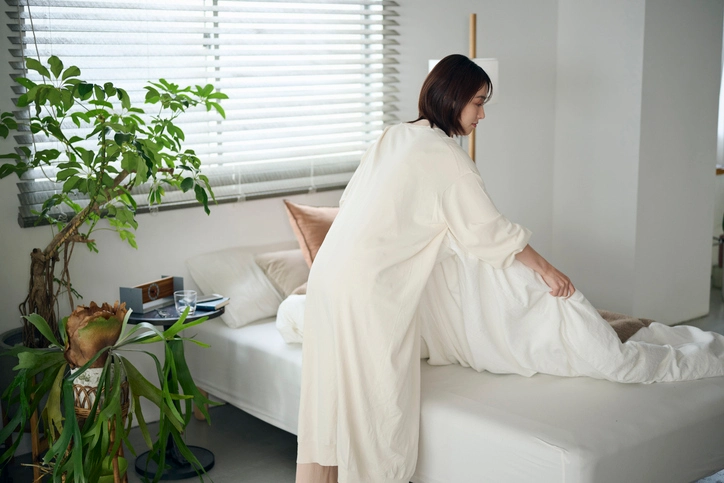
Traditionally, many homes use futons (foldable mattresses) on tatami (woven straw mats), which can be rolled up and stored in the closet during the day. Historically, futons come in just one basic size—there’s no “king,” “queen” or “single.” People measure sleep space by counting futons: one futon, two futons. Each person gets their own.
So “sleeping together” simply means placing futons side by side. Even small children often have their own small futon placed next to a parent’s. There’s even a saying that a happy family sleeping together looks like the kanji 川, each line representing a person lying closely but separately.
A couple might start out sharing a room or bed, but after a baby comes along, one parent often moves to the other room to get real sleep. Over time, that arrangement sticks.
When Kids Take Over
Another major factor? Co-sleeping with kids.
According to a 2013 study on sleeping practices of Japanese preschool children, 87% of kids shared a bedroom with their parents—sometimes a futon, sometimes a bed barely big enough for two adults, let alone three. Culturally, there’s little pressure to push for independent sleeping early on. If anything, the family bed is seen as warm and emotionally supportive.
But it often results in one parent getting nudged out…or making a strategic retreat to the other room.
Separate Beds Can Actually Be Good for a Relationship
Sleeping apart can help couples maintain a stronger bond. It eliminates the small irritations that quietly build resentment over time — blanket theft, snoring, midnight bathroom trips. And in Japan, physical closeness isn’t the default expression of love. You’ll rarely see couples kiss or hug in public, and affection tends to be more subdued than in the U.S. or Europe.
That doesn’t mean intimacy is absent. It just happens on a different schedule, sometimes in a different room. (And sometimes while the kids are at school and the house is blissfully quiet.) The idea of visiting rather than permanently sharing a bed also echoes older customs of intimacy.
In premodern Japan, a practice called yobai (night-crawling) involved a lover quietly visiting another’s room at night and leaving by morning. It was generally consensual — often part of courtship rather than secrecy — and the act of granting someone permission to enter your room was itself a gesture of trust. Since the sleeping space was typically a single futon meant for one, letting someone into it signaled real affection.
Interestingly, a similar tradition still exists among the Mosuo people of Yunnan, China, whose so-called “walking marriages” (zǒuhūn) allow partners to visit one another at night while maintaining separate households. In both cases, intimacy was imagined through movement and approach, not through constant proximity.
Some Couples Do Come Back Together
It’s not a permanent arrangement for everyone. Some couples sleep apart for a few years while the kids are young, then return to sharing a room. Others keep the separate setup but have occasional sleepovers in each other’s rooms — yes, like dating again. One friend even joked that it made things more exciting. She wasn’t wrong.
There’s no one-size-fits-all model here, and that flexibility is genuinely refreshing.
Should You Try Separate Sleeping?
If you’re living in Japan with a partner and struggling to sleep, you’re not alone. Separate beds, futons, and even separate rooms are options many couples embrace without guilt. And if you’re raising young kids in a small space, it might be the smartest solution you haven’t considered yet.
Sleep doesn’t have to come at the cost of connection. For many Japanese couples, separate sleeping is precisely how they stay connected — by being better rested, less irritable, and more present during waking hours.
Sharing a bed every night isn’t a universal rule. It’s a cultural habit. And in Japan, that habit happens to lean toward better sleep and a little more room to breathe.
More Reads You Might Like:
Why Do 84 Percent of Women in Japan Think Cheating is Healthy?