Endemic Species That Only Exist on Specific Japanese Islands
Japan's remote southern islands have quietly produced some of the world's rarest wildlife
Roughly half of Japan’s mammal species are endemic. And the further south the archipelago reaches, the more singular its passengers become, each tied to the soil of one specific shore. Tourism, roads and feral cats are the modern threats; geological isolation is the ancient gift. Both, in their own way, are still doing their work.
Amami Rabbit — The Living Fossil
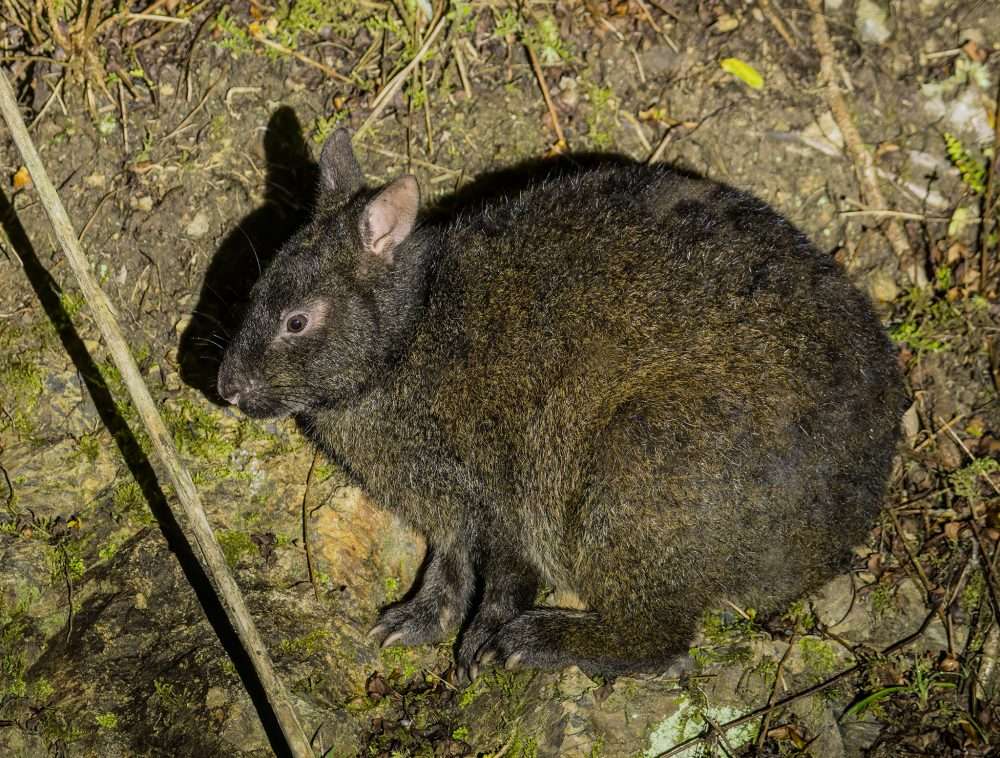
Hidden in the laurel-covered ridges of two small southern islands lives a rabbit that should not exist. The Amami rabbit is dark, stocky, almost scowling—with the short ears and curved claws of a creature better suited to the Pleistocene than to the present day. It is, quite literally, the only kind left.
Across mainland Asia, its primitive ancestors were outcompeted millions of years ago by the swifter, longer-eared rabbits we know today. But on Amami Oshima and Tokunoshima, isolated from the continent before the upgrade arrived, the old design simply kept going. Genetic studies trace its lineage back to ancestors that hopped through Eurasia some six million years ago.
It is nocturnal, solitary and almost impossible to see. Burrows are carved into forest slopes; mothers visit their young only briefly each night, blocking the entrance with soil to hide them from predators that once did not exist. Mongooses, introduced in 1979 to control venomous habu snakes, became the rabbit’s catastrophe. An island-wide eradication program, declared a success in 2024, has finally given this ancient creature a chance to breathe.
アマミノクロウサギ
Pentalagus furnessi
Range: Amami Oshima & Tokunoshima 820 km² (two islands, Kagoshima Pref.)
Population: ~12,000 (2021)
IUCN: Endangered · Recognized 1921 (Japan’s first Natural Monument)
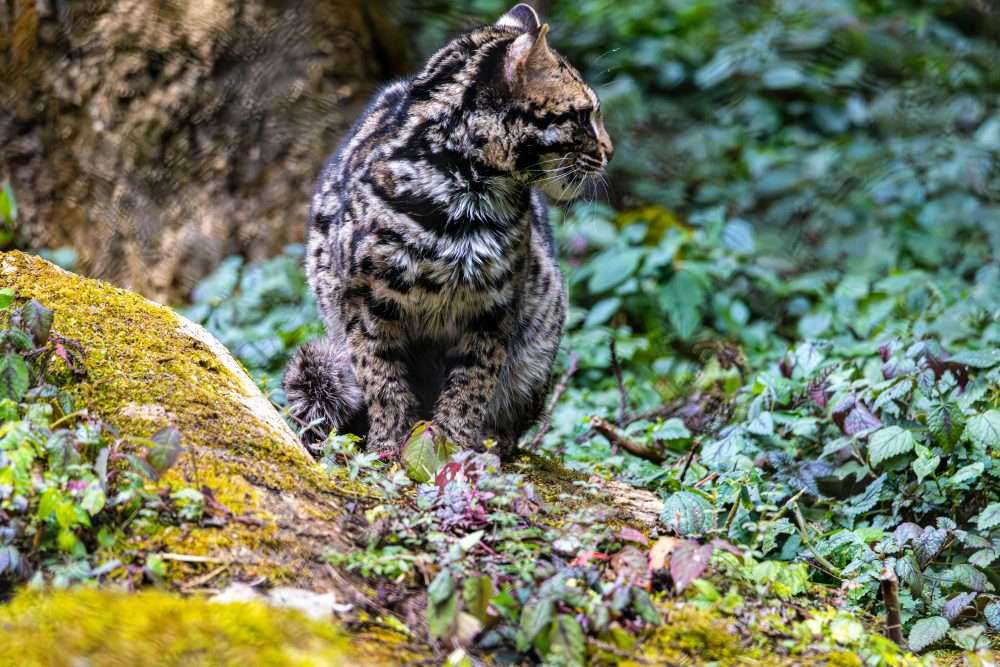
Iriomote Cat — The Shadow Cat
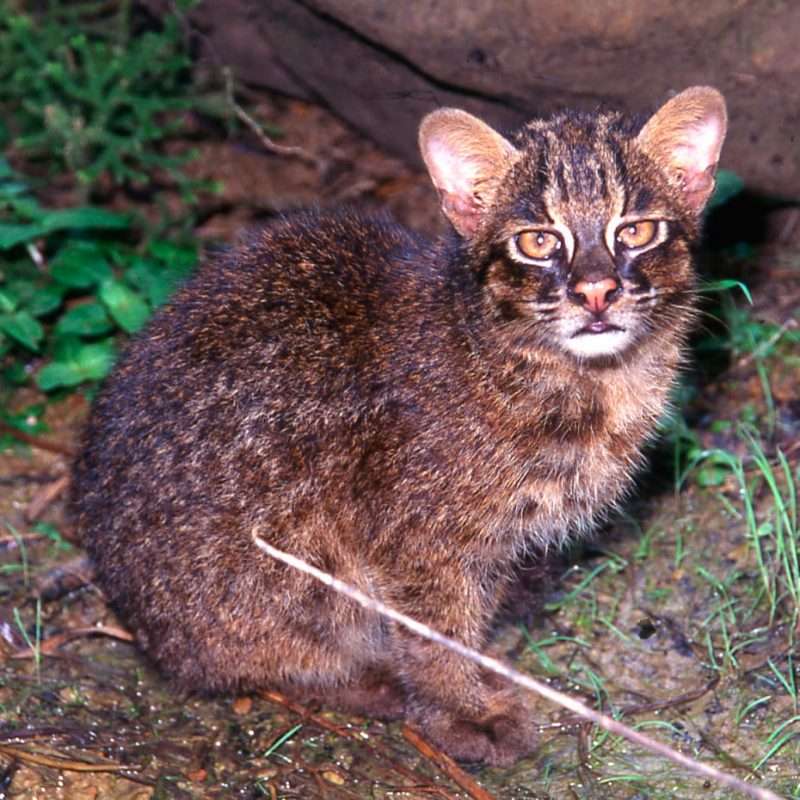
Iriomote is an island of mangrove rivers and unmapped jungle, 90 percent covered in forest, with one road that loops the coast. Somewhere in that interior—though almost no one ever sees one—lives a cat unknown to science until 1965. The locals had names for it: yamapikaryaa, “that which shines in the forest”; meepisukaryaa, “that which has flashing eyes.”
About the size of a stocky house cat, the Iriomote cat occupies the smallest territory of any wildcat on Earth. With so few small mammals on a 284-square-kilometre island, it has evolved a uniquely catholic appetite: lizards, fruit bats, river prawns, crabs, even fish snatched from streams. It swims well. It climbs when it has to. It hunts mostly at dawn and dusk along the lowlands, exactly where humans also live.
That overlap is the cat’s central problem. Cars are the leading cause of death; resort development chips at its hunting grounds; feral domestic cats spread disease and dilute the gene pool. Iriomote joined the UNESCO World Heritage list in 2021, doubling tourism and doubling the tension. About 100 individuals remain. Every life matters.
イリオモテヤマネコ
Prionailurus bengalensis iriomotensis
Range: Iriomote-jima, Okinawa 284 km² (Iriomote-jima only)
Population: ~100, declining
IUCN: Critically Endangered · Described 1967
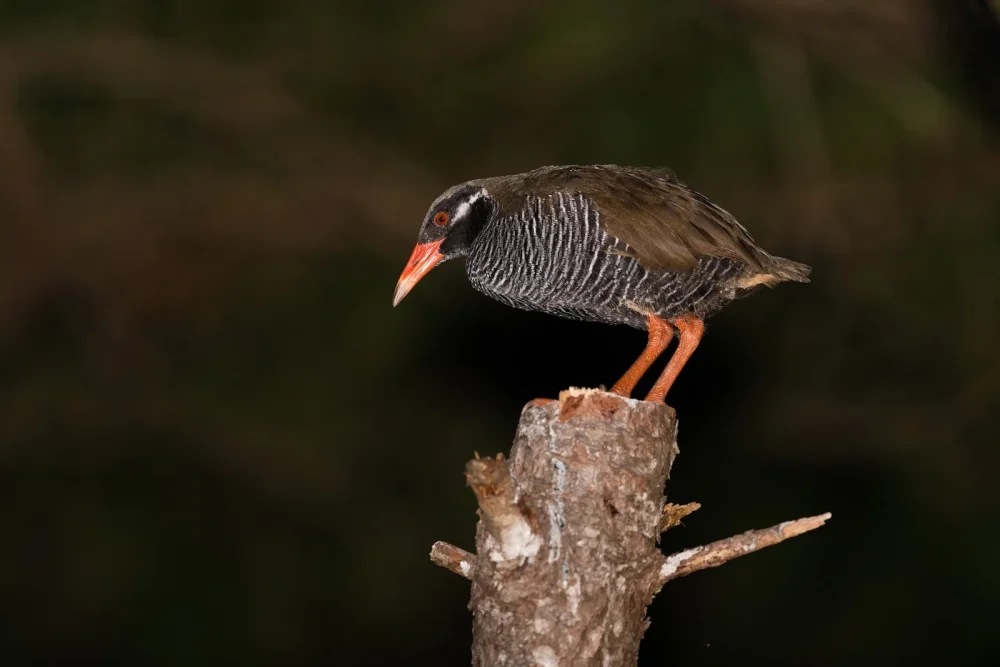
Yanbaru Kuina/Okinawa Rail — The Flightless Voice
Yanbaru, the dense subtropical forest at the northern tip of Okinawa Island, hides a bird that ran out of reasons to fly. In an environment with few predators, the Okinawa rail spent millennia shedding the very equipment that defines most birds. Its wings shrank. Its legs thickened. Today it tears through the underbrush on long, vermilion legs, calling in a clattering duet at dawn that pairs use to mark their patch of forest floor.
It was unknown to science until 1978, astonishingly recent for a creature so loud. Locals, of course, had known it forever, calling it agachaa, “the flustered one.” The new species announcement made national news; the bird became the symbol of Yanbaru, and the village of Kunigami adopted it as its official mascot.
But flightlessness, so elegant in an island vacuum, becomes a liability the moment outsiders arrive. Mongooses, feral cats, traffic on logging roads, none of it existed when the wings were busy disappearing. Yanbaru was made a national park in 2016, and a UNESCO World Heritage site in 2021, and intensive predator control has the rail’s numbers slowly creeping upward again.
ヤンバルクイナ
Hypotaenidia okinawae
Range: Yanbaru forest, northern Okinawa 260 km²
Population: ~720, incl. 480 mature adults
IUCN: Endangered · Described 1981 (last major Japanese bird find)
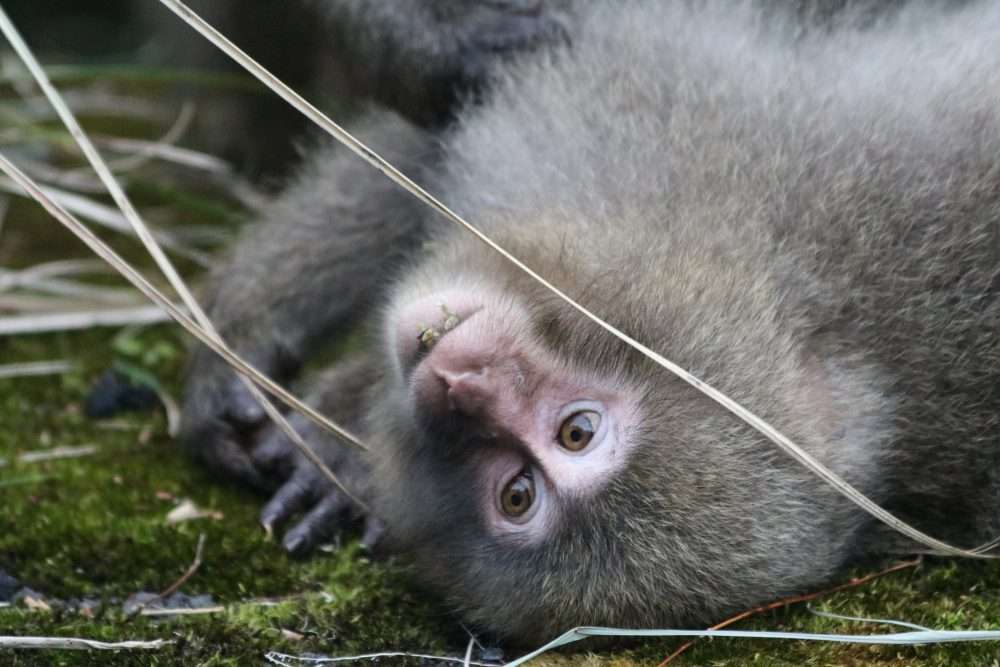
Yakushima Macaque — The Island Cousin
Yakushima is barely 500 square kilometres of mountain rising sharply out of the East China Sea. It’s small enough to circle in an afternoon, big enough to grow cedars that have lived for thousands of years. Cut off from Kyushu for long enough to matter, the macaques here have drifted into something subtly their own: shorter, darker, shaggier than their mainland relatives, with denser coats suited to the island’s relentless rain.
Most authorities now treat the Yakushima macaque as its own subspecies, and a few argue for species status outright. They live in tight matrilineal troops, foraging for fruit, leaves, fungi and the occasional crab on the shore, sharing the forest with the equally endemic Yaku-shika, a miniature sika deer that is sometimes seen cleaning up the macaques’ fallen scraps.
Of the four animals in this article, this is the one a visitor is likeliest to actually meet. They cross the island’s coastal road without much concern, peer through windscreens at parked cars, and occasionally raid the unattended bento of an inattentive hiker. Familiar, but only here. Step off the ferry at Kagoshima, and they vanish.
ヤクシマザル
Macaca fuscata yakui
Range: Yakushima ~500 km²
Population: several thousand, stable
IUCN: Least Concern · Cohabitant: Yaku-shika (also endemic)
Curious about more of Japan’s wildlife? Check out:
Wildlife in Tokyo: Tokyo Safari