Giant Buddhist Statues to Visit Near Tokyo
Eight Buddhist statues within a day trip of Tokyo, from a cliff-carved Buddha to a 120-meter bronze giant
An hour from Tokyo, a bronze Buddha rises 120 meters above the rice fields of Ibaraki, tall enough to hold Nara’s famous Great Buddha in the palm of its hand. It’s the largest of several giant Buddhist statues scattered across the prefectures around the capital. Some date back centuries, while others went up within living memory. One sits in the cliff face of an old stone quarry. Stairs inside another lead all the way to her crown, with views over Tokyo Bay.
Most lie within two hours of central Tokyo, making them easy day trips for anyone curious about Japanese Buddhism, local history or simply seeing something on an unusual scale.
Buddha or Kannon?
These figures fall into two main groups. A daibutsu (great Buddha) depicts a Buddha—a fully enlightened being. They are usually seated in meditation, with calm faces, plain robes and hands held in symbolic gestures. The Great Buddha of Kamakura, for example, represents Amida, the Buddha of Infinite Light.
Kannon (the bodhisattva of compassion) is different. A bodhisattva has reached enlightenment but chooses to remain in the world to help others. Kannon statues often stand rather than sit and wear crowns, jewelry and flowing garments. Many have a gentle, feminine look, and several of the tallest are painted white.
Why Make the Trip
Size is only part of the appeal. Many of these monuments sit on hillsides or near the sea, with sweeping views and quiet temple grounds. Others offer a look at centuries-old craftsmanship and the faith behind it. Here are eight giant Buddhas and Kannons worth the journey from Tokyo.
Kamakura Area
Once the seat of Japan’s first shogunate, the seaside city of Kamakura is best known for Tsurugaoka Hachimangu Shrine and the snack stalls of Komachi Street. It also holds some of the region’s most famous Buddhist statues.
Kamakura is about an hour from Tokyo Station on the JR Yokosuka Line, or from Shinjuku on the JR Shonan-Shinjuku Line. No transfers are needed.
The three statues below sit just a few stops apart. With an early start, all of them fit comfortably into a single day.
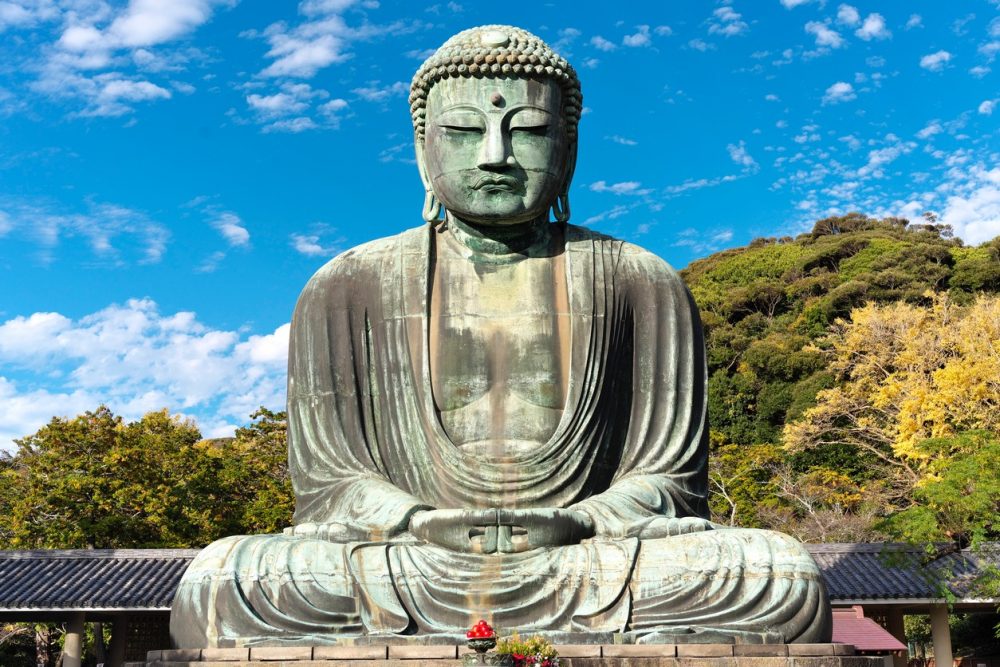
1. Kamakura Daibutsu
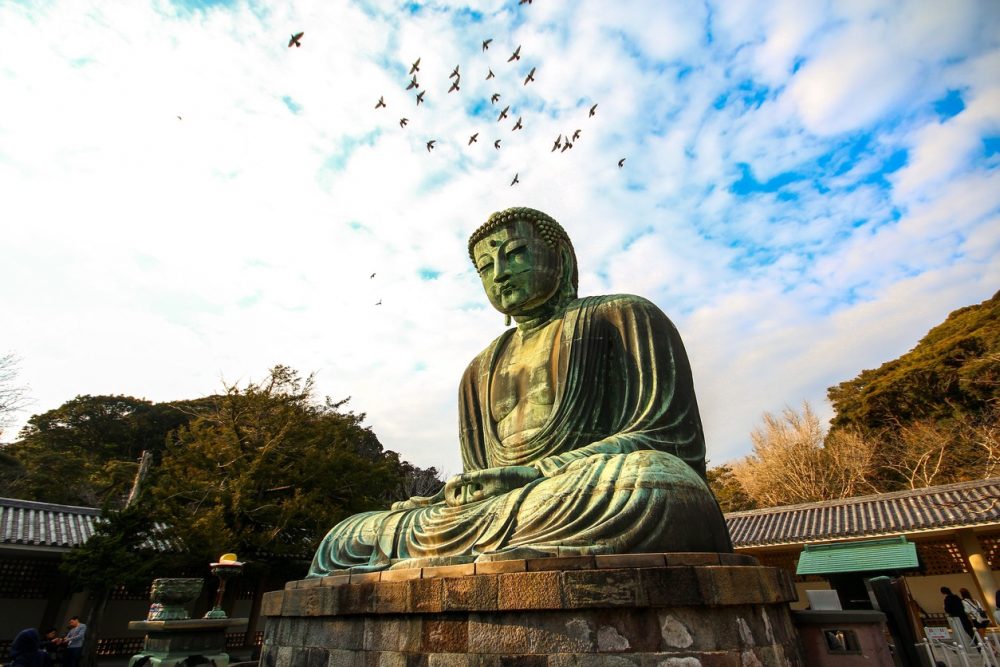
The Great Buddha of Kamakura is one of the most recognizable statues in Japan. It stands on the grounds of Kotoku-in, a temple a short walk from Hase Station.
The bronze figure depicts Amida Buddha seated in meditation. It measures roughly 11 meters tall, or more than 13 meters including its base, and weighs over 120 tons. Work on the statue began in 1252.
A large wooden hall once housed the statue. Storms and a tsunami destroyed the building centuries ago, and the Buddha has sat in the open air ever since. That outdoor setting, framed by trees and sky, is a big part of its appeal today.
Japan lists the statue as a National Treasure. For a small extra fee, step inside the hollow body and see how craftsmen cast it in sections.
Admission: ¥300 (interior ¥50 extra)
Access: Seven-minute walk from Hase Station, three stops from Kamakura, on the Enoden line
2. Hase Kannon
Credit: Courtesy of Hase-dera
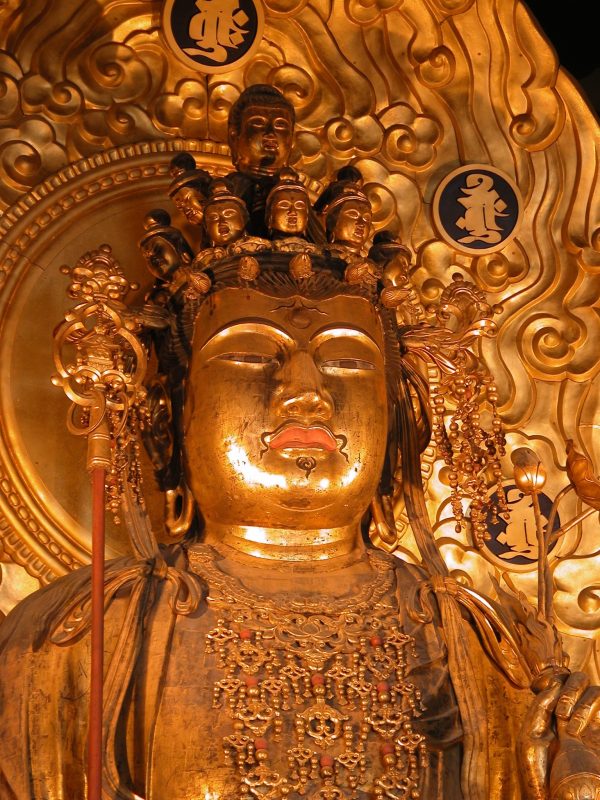
About five minutes on foot from the Great Buddha is Hase-dera, a hillside temple overlooking Sagami Bay. Its main hall, the Kannon-do (Kannon hall), sits at the top of a flight of stone steps and houses the temple’s most treasured figure.
The gilded wooden statue stands just over nine meters tall, making it one of the largest wooden statues in Japan. It depicts Juichimen Kannon (Eleven-Faced Kannon). Ten smaller faces crown the main head, each said to look out in a different direction. Together, they represent Kannon watching over and responding to suffering wherever it occurs. Some faces are calm, others stern or smiling—a reflection of the many ways compassion can take shape.
The statue comes with a striking origin story. According to temple legend, a monk in Nara carved two Kannon figures from a single giant camphor tree in 721. One stayed in Nara, enshrined at a local temple. The other went into the sea, along with a prayer that the waves would carry the figure to the people who needed Kannon most. Fifteen years later, the statue reportedly washed up glowing on a beach near Kamakura. Hase-dera rose on the hillside above to house the wandering Kannon.
The temple bans photography of the statue, so take a few quick minutes to stand before Kannon in person. Cameras can come back out on the rest of the grounds, where hydrangeas fill the gardens in early summer and a lookout opens onto views across the bay.
Admission: ¥400
Access: Five-minute walk from Hase Station on the Enoden line
3. Ofuna Kannon
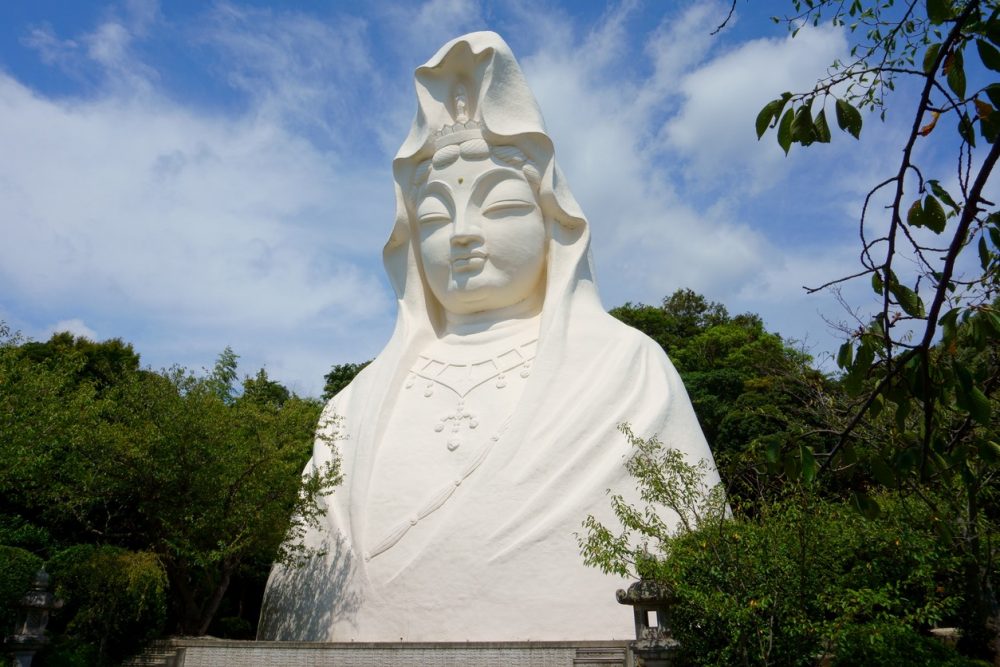
Two stops from Kamakura on the JR Yokosuka Line, a huge white figure rises above the trees beside Ofuna Station. Most passengers spot it from the train window before the doors even open.
The bust of Ofuna Kannon gazes out from a hillside temple. Standing 25 meters tall, it is built from reinforced concrete—a much younger figure than its Kamakura neighbors. Workers poured every section by hand, without the help of concrete pump trucks.
Work began in 1929 as a prayer for world peace. With war approaching, construction stopped in 1934, leaving only the frame in place. A newly formed society revived the project in 1954 and finished the statue in 1960. The grounds also hold a memorial to the victims of Hiroshima and Nagasaki.
Step through the door at the back of the statue, and a small shrine and museum wait inside the base. Buddhist images and offerings line the walls, alongside photos from the three decades of construction.
Compared with the Great Buddha, the grounds are compact and rarely busy. A short visit is enough, though the benches facing the statue invite a quiet pause.
Admission: ¥300
Access: 10-minute walk from Ofuna Station (west exit)
Boso Peninsula, Chiba
Across Tokyo Bay from Kanagawa, the Boso Peninsula trades city crowds for fishing ports, coastal hills and long stretches of sea views. It sees far fewer international visitors than Kamakura, which makes for a slower, quieter day out.
The JR Uchibo Line runs down the western coast from Tokyo Station, reaching the area in roughly 90 minutes to two hours. Coming from Kanagawa instead? The Tokyo Wan Ferry crosses from Kurihama to Kanaya, a short walk from the Mount Nokogiri ropeway.
The two statues below sit a few stops apart on the same train line, so both fit into one day.
4. Mount Nokogiri: Nihon-ji Daibutsu and Hyaku-shaku Kannon
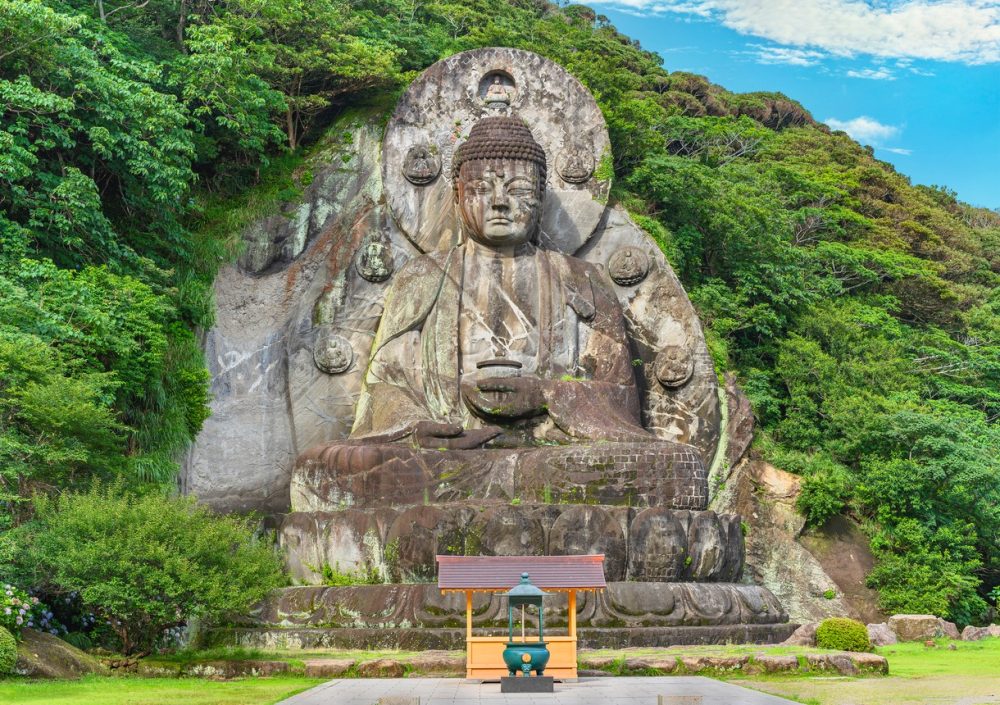
Nihon-ji Daibutsu
On the slopes of Mount Nokogiri—Nokogiriyama (Saw Mountain) in Japanese, named for its jagged, quarried ridgeline—sits Nihon-ji, one of the oldest temples in the Kanto region, founded in 725. Its grounds hold not one giant figure but two.
The first is the Great Buddha, carved straight into the rock face. The seated figure depicts Yakushi Nyorai (the Medicine Buddha) and stands 31.05 meters tall, making it the largest premodern stone-carved Buddha in Japan. Work took three years, from 1780 to 1783. Centuries of weathering wore much of it away, and restorers rebuilt it in 1969.
Higher up the mountain is its counterpart. Cut into a sheer quarry wall in 1966, the Hyaku-shaku Kannon (hundred-foot Kannon) rises 30.3 meters, nearly matching the Buddha below. Standing at its base and looking up at the cliff gives a strong sense of the scale involved.
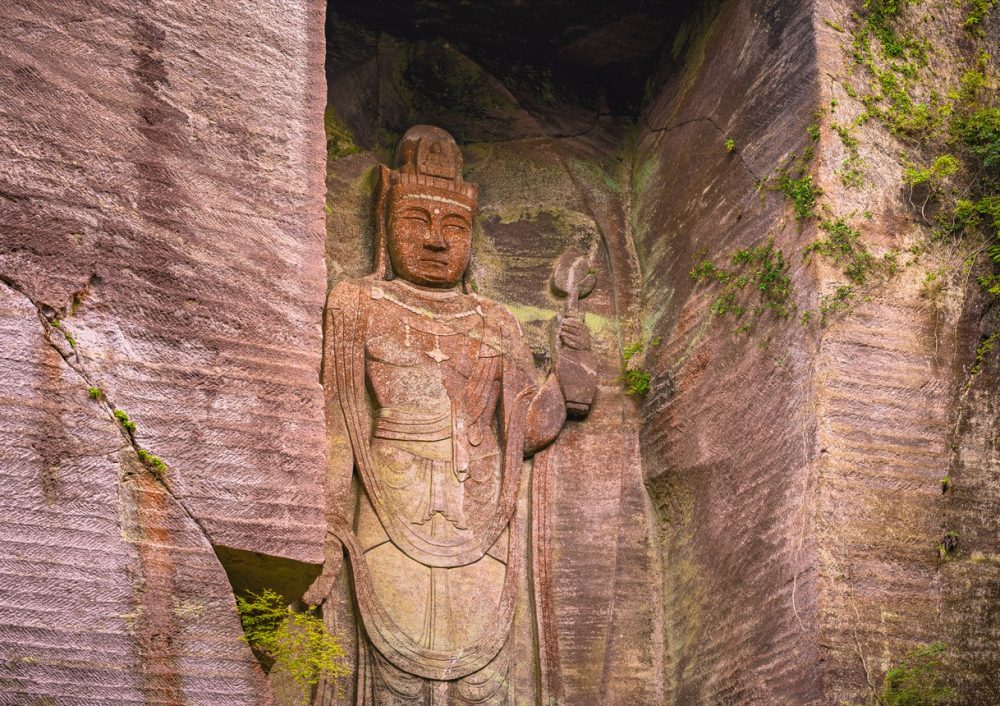
Hyaku-shaku Kannon
More than 1,500 rakan (disciples of the Buddha) statues line the paths between the two. Close by is Jigoku Nozoki (Peek into Hell), a rock ledge jutting out over a drop of more than 100 meters, with the ocean beyond.
Expect plenty of stone steps. Most visitors spend two to three hours on the mountain, and the last entry is at 3pm—so an early start helps, especially when pairing it with the next entry on this list.
Admission: ¥700 (Mount Nokogiri ropeway ¥1,200 round trip)
Access: Short walk from Hamakanaya Station to the ropeway, then a four-minute ride
5. Tokyo Wan Kannon
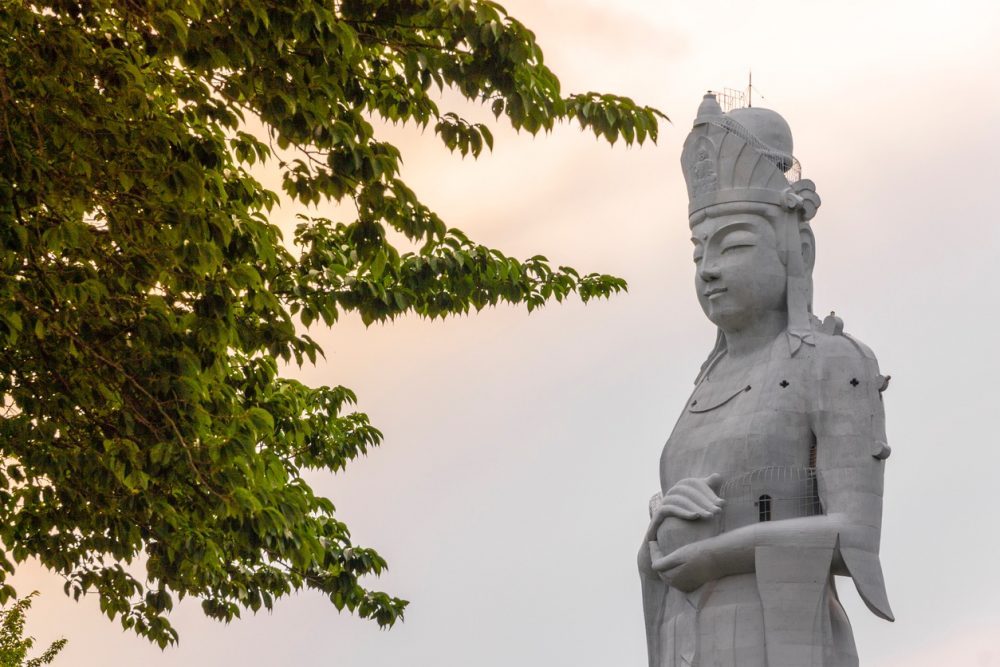
Gazing out over the mouth of the bay from a hilltop in Futtsu, Tokyo Wan Kannon (Tokyo Bay Kannon) rises 56 meters above the coast. The white figure is visible to ships entering the bay.
Masae Usami, a Tokyo lumber merchant, built the statue in 1961 with his own money. It honors those who died in wars around the world and serves as a prayer for peace.
Around 20 floors and 324 steps wind up through the hollow interior to the crown. Small windows and lookouts along the way frame views of Tokyo Bay, as well as Mount Fuji on clear days.
Admission: ¥500
Access: 25-minute walk from Sanukimachi Station on the JR Uchibo Line
Ibaraki
Northeast of Tokyo, Ibaraki is a largely rural prefecture of farmland, lakes and quiet towns. The area surrounding Ushiku sits near Lake Kasumigaura, Japan’s second-largest lake, and is also home to the country’s first winery.
Ushiku is about an hour from Ueno on the JR Joban Line. The statue below has no giant neighbors nearby, but its sprawling grounds easily fill a day on their own.
6. Ushiku Daibutsu
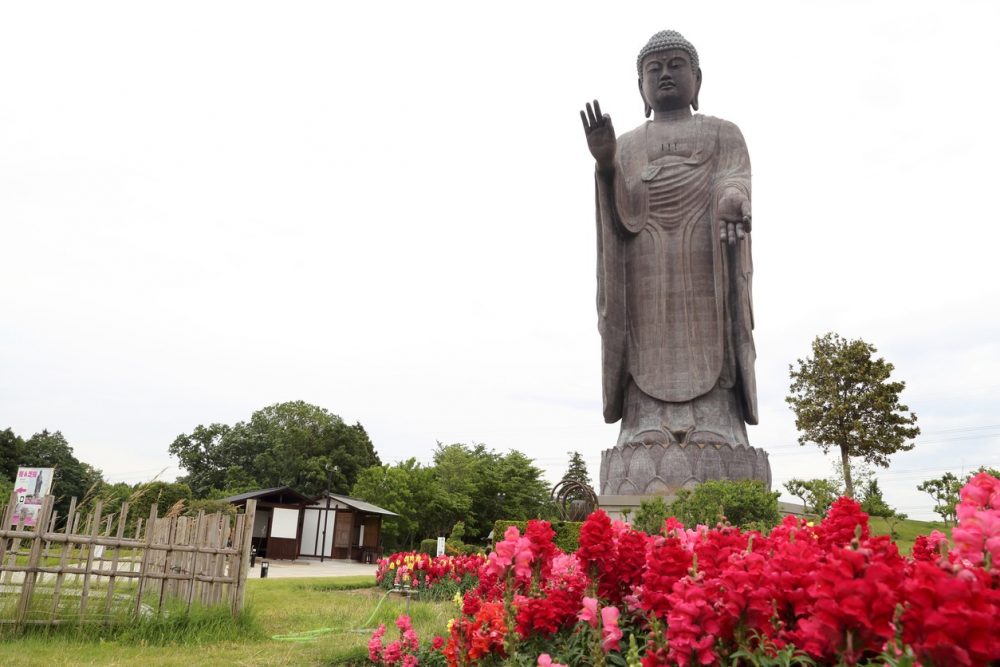
Rising above the fields of southern Ibaraki, Ushiku Daibutsu is visible from kilometers away. The bronze figure stands 120 meters tall, including a 20-meter base, and holds the Guinness World Record for the tallest bronze Buddha statue.
It depicts Amida Buddha, and the height is symbolic—a nod to the 12 rays of light the Buddha is said to cast over the world. Higashi Honganji, a head temple of Jodo Shinshu (True Pure Land Buddhism), completed the statue in 1992. The location honors Shinran, the school’s founder, who made this region the base for spreading his teachings.
Inside Ushiku Daibutsu, five floors hold exhibits on its construction, a space for copying sutras and a hall lined with some 3,400 small gilded Buddhas. An elevator rises to an observation deck 85 meters up, where clear days bring views as far as Tokyo Skytree and Mount Fuji.
Around its base, the grounds spread out into a traditional garden, seasonal flower fields and a small animal park. On weekends and holidays, tickets to the interior can sell out, so arriving early is a good idea.
Admission: ¥800 (interior and gardens); ¥500 (gardens only)
Access: About 30 minutes by Kanto Tetsudo bus from JR Ushiku Station (bound for Ushiku Joen), getting off at Ushiku Daibutsu
Saitama
Just north of Tokyo, Saitama is best known for the old merchant streets of Kawagoe. Farther west, the prefecture rises into the forested hills of Okumusashi and Chichibu, an area of river valleys, hiking trails and small mountain temples.
The Seibu Ikebukuro Line runs from Ikebukuro into these hills, making the area easy to reach from the city. Torii Kannon is more remote than the Kamakura statues, so expect a bus ride and an uphill walk on top of the train.
7. Torii Kannon
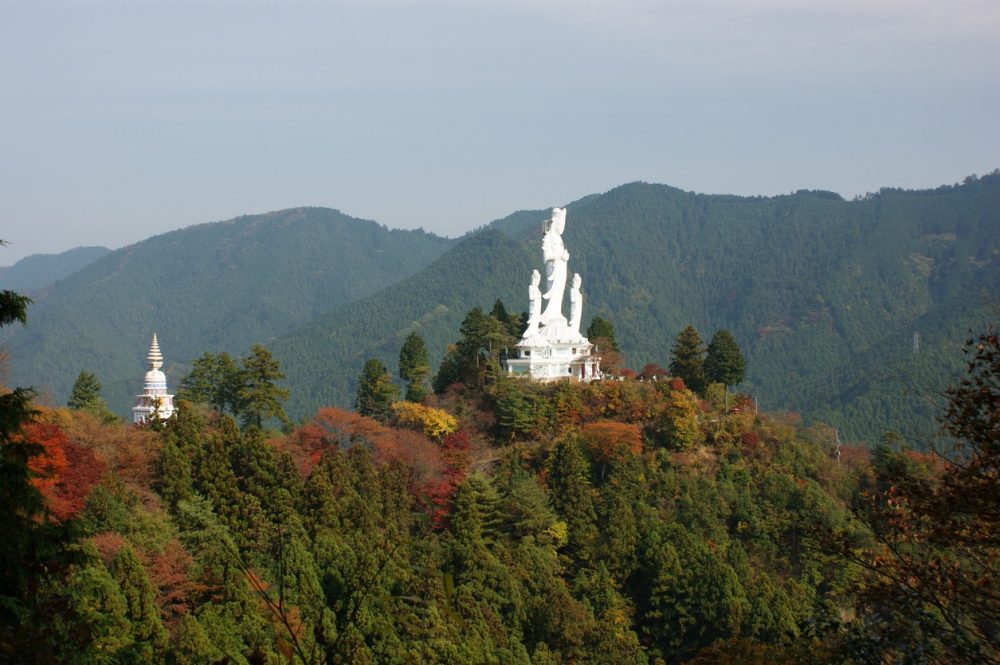
High in the Naguri Valley outside Hanno, three white figures stand side by side on a mountaintop at Torii Kannon temple. Called Kyusei Daikannon (Great Kannon of Salvation), the group reaches 33 meters in total. A 23-meter Kannon stands at the center, flanked by Bonten and Taishakuten (Buddhist guardian deities derived from Brahma and Indra), each just as tall.
The temple is the life’s work of one man. Yataro Hiranuma, a local forestry businessman, banker and politician, founded it to honor his late mother’s devotion to Kannon. He spent more than 30 years building its halls, gates and statues across a hillside of about 300,000 square meters. Hiranuma completed the great Kannon trio in 1971.
Inside the base, roughly 10,000 small Kannon figures line the walls, with stained glass circling the ceiling. A viewing platform 27 meters up looks out over the surrounding peaks. The interior is open on weekends and holidays from April to November only.
Reaching the summit takes about 45 minutes to an hour on foot, passing colorful halls and a pagoda dedicated to Xuanzang, the Chinese monk who inspired “Journey to the West.” The climb is at its best in autumn, when maples around the temple turn deep red from late October through November.
Admission: ¥200 (Daikannon interior ¥200 extra)
Access: About 45 minutes by Kokusai Kogyo bus from Hanno Station (bound for Naguri), getting off at Renkei-bashi, then a five-minute walk
Gunma
Northwest of Tokyo, Gunma is best known for hot spring towns like Kusatsu and Ikaho and for the mountains that ring the prefecture. Its second city, Takasaki, is a major rail hub—about an hour from Tokyo Station on the Joetsu or Hokuriku Shinkansen.
That makes the city’s landmark statue one of the quickest trips on this list, despite the distance.
8. Takasaki Byakui Kannon
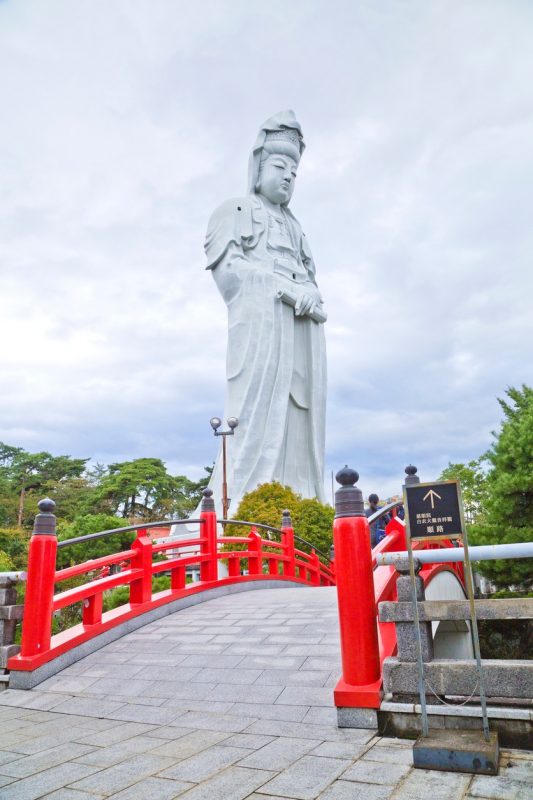
Looking out over Takasaki from the top of Kannonyama (Mount Kannon), the Byakui Daikannon (Great White-Robed Kannon) has been the city’s symbol since 1936. The concrete figure stands 41.8 meters tall and weighs around 6,000 tons. At its completion, it ranked as the largest statue of its kind in East Asia. Its white robe represents a pure mind seeking enlightenment.
The statue was the vision of local businessman Yasusaburo Inoue. He built it to support Takasaki’s growth, to honor soldiers of the city’s 15th Infantry Regiment and to spread Kannon’s compassion. Today, it belongs to Jigen-in, a temple of the Koyasan Shingon school, and is a registered cultural property.
Inside, 146 steps climb through nine floors to the statue’s shoulders. Twenty Buddhist figures and statues of revered monks line the way. Windows on each level look out over the city, the Kanto Plain and the three main peaks of Gunma. Most visitors make it to the top in roughly 15 minutes—there’s no elevator.
Outside, the hilltop grounds are free to wander. Cherry blossoms frame the statue in spring, and a 120-meter suspension footbridge links the area to a nearby botanical garden.
Admission: Free (grounds); ¥300 (interior)
Access: About 20 minutes on the Gururin Kannonyama Line bus from Takasaki Station’s west exit, getting off at Byakui Kannon-mae, then a two-minute walk
From a nearly 800-year-old bronze Buddha to a hilltop Kannon built in living memory, each of these statues tells a different story about faith in Japan. Most are easy to reach in a day, and several pair well with nearby sights.
Planning more trips out of the city? See our guides to Kawagoe, Enoshima, Utsunomiya and Yokosuka.