June 24, 2010
Picture This: An Interview with David Stetson
After scaling the heights of the New York fashion world, photographer David Stetson rediscovers his muse in Tokyo.
By Metropolis
To be an artist, you need two things: technical skill and inspiration. Acquiring the former is not an impossible task. Some people pick it up on their own through trial and error; others go to school to sharpen their skills. And still others just seem to be born with a natural aptitude.
Inspiration, on the other hand, is much harder to come by. All the skill in the world will still leave you with mediocre, if technically flawless, work unless it has that little flicker of life, that extra quality that transforms craft into art. Inspiration is a fickle thing, and many an artist has lain awake in the dead of night, wondering when or whether it will visit them again. If inspiration abandons them, artists can go to any lengths to recapture the muse, even if it means traveling to the opposite side of the earth. As British photographer David Stetson will attest, sometimes that’s exactly what you have to do.
Portraits of Power and Pop Culture
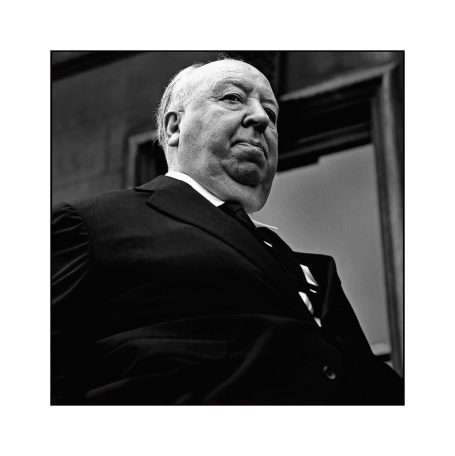
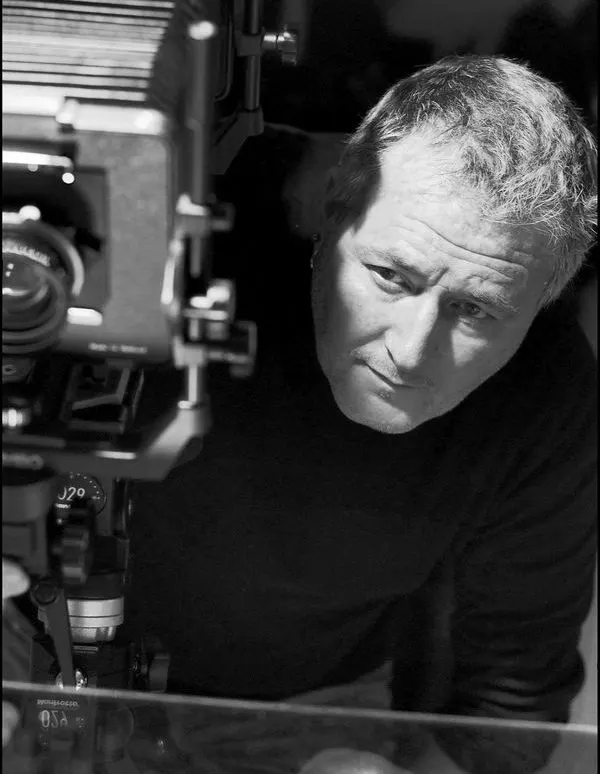
Stetson, 56, started his career in London in the early ’70s. Like many young photographers, he spent several years as an assistant to more established lensmen, gaining contacts and experience. But when the time came to strike out on his own, he was faced with a dilemma.
“My original desire was not to be a fashion photographer per se,” he explains at his newly opened Yoyogi studio. “I just wanted to be a photographer—I love taking pictures and I just wanted to create images through photography.”
However, economic realities force most freelance photographers to concentrate in a particular field. When an agency or a magazine is looking to commission a shoot, they’ll usually choose someone whose portfolio is stocked with photos like the ones they want to create.
The Big Question
“When I realized that I had to specialize, the obvious question was, ‘What should I specialize in?’” Stetson recalls. “And of all the photographers I worked for as an assistant, it occurred to me that the fashion guys had more fun than anybody else. So that’s what I chose.”
While it’s notoriously difficult for photographers to break into the editorial fashion field, Stetson worked his contacts and devised a clever strategy to get face time with the editors.
“I offered my services free of charge to up-and-coming designers who were holding fashion shows,” he recalls. “In return for prints, they would furnish me with a list of the fashion editors that would be present at the show, in particular, the editors who were there without their own photographers. I’d then call these editors and ask for an appointment to show my work—and I’d quickly add that I had authorized photos from [that] morning’s show.”
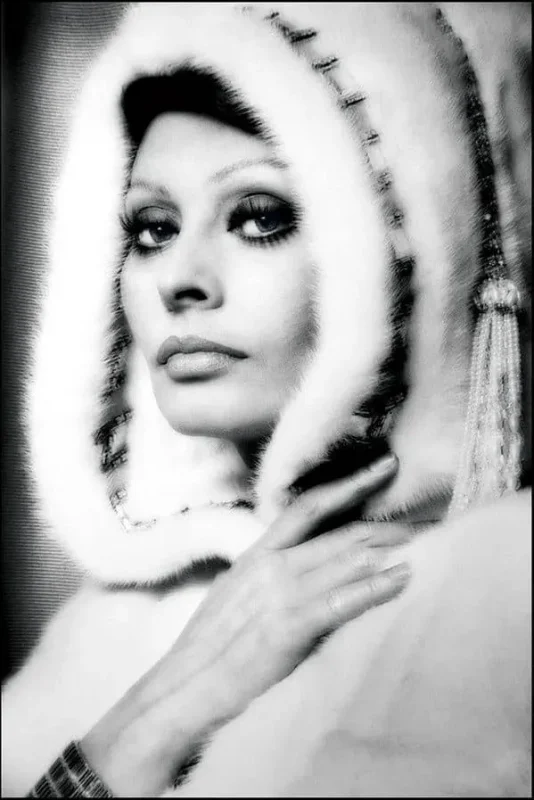
Before long, Stetson was working for prestigious publications like Harpers & Queen and The Sunday Times Magazine, as well as some of the biggest names in the fashion world: Max Factor, Givenchy, Christian Dior.
By the late ’70s, the photographer was shuttling between New York and London, eventually setting up his own studio in Manhattan. He found an agent to sponsor his visa, and discovered that his spontaneous style was a good fit for the lifestyle-focused photographs that were coming into vogue at the time. Jobs just kept rolling in—along with sizable fees—and David Stetson photographs began turning up everywhere from Glamour to the South African Cosmopolitan, and every fashion house in between.
The lifestyle of a hot young photographer in the ’80s New York fashion scene was as seductive and entertaining as you’d imagine it to be—parties galore, and no end of interesting people to rub elbows with. Stetson found himself traveling all over the world for his work, from European capitals to uninhabited Caribbean islands.
A Change of Course
After ten years in the thick of the NYC scene, however, the photographer was beginning to feel that neither his heart nor his head was really in it anymore. So in 1989, he moved back to London and sought other outlets.
“One of the reasons I didn’t like fashion was the superficiality about the whole industry,” he says. “That’s what finally got to me—I was lying. The only thing that I was sincere about was getting the picture, so if I had to say or do a certain thing or flirt like crazy so [the models] would think that there was something going on, so that they would give me a little more than they would someone else, I would do it. But there wasn’t really. It was all for the picture.”
The late-’80s shift in the fashion industry toward grunge and “heroin chic” also turned him off. “That was it for me, because suddenly fashion became ugly and I just didn’t want to compete, I didn’t like it. It just didn’t look beautiful.”
Stetson began mulling over his career options and started dabbling in art photography, but he was also struggling with a major creative crisis—that flighty mistress, Inspiration, had gone AWOL.
“I’ll tell you what started it: Fellini’s 8 1/2.” he recalls. “Somehow, there was something about what was going on in my life at the time, and then seeing that film, I thought, ‘Can that really happen? Can you really lose the creative energy, whatever it is that enables you to take pictures?’ And I thought I had lost it. I thought it had gone… I just thought I’d lost the ability to take good pictures.”
And then, a bolt from the blue: a stock photography agent in Japan had a client who had used Stetson’s photos and wanted to commission a shoot. The agent wanted to know if the photographer would come to Japan.
“You won’t believe what the first few [assignments] were,” he recalls of his early work here. The famed fashion photographer was brought all the way across the Pacific to take pictures not of Bubble-era craziness, Omotesando fashionistas, or the burgeoning Shibuya-kei scene, but… for jigsaw puzzles.
“There was a period when jigsaw puzzles were a major fad in Japan,” he recalls. “A lot of my stock pictures that had been purchased while I was in New York were for jigsaw puzzle use, and I didn’t know it at the time, but I actually had 36 puzzles on the market—with my name on them. And the funny thing was, they introduced them as the ‘David Stetson series of jigsaw puzzles,’ but then they’d take sections of my bio as slogans. Because they love slogans, but the slogan doesn’t actually have to mean anything: they just like words in English. So they’d take a random piece out of my profile and just drop it in.”
As silly as it sounds, the jigsaw puzzles and other Japan-based assignments brought the spark back to his work.
Life in Tokyo
“Coming to Japan rekindled my love of photography. I found myself surrounded by inspiration, by images, by things that were so unfamiliar to me it made me want to photograph them. And when I saw the pictures, I liked the pictures, which encouraged me to take more. Suddenly, I was a good photographer again! It sounds sort of conceited and arrogant to say that, but I was excited. I found that I was inspired by Japan, by the surroundings… And it persisted.”
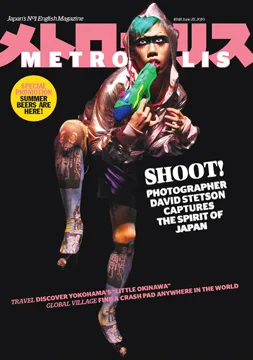
Stetson officially relocated to Tokyo in 1992 and has been here ever since. Along with the new surroundings, the photographer has adopted a fresh approach. Although he continues to do some fashion work, he refuses to be constrained by that label any longer.
Beginning with the puzzle projects, Stetson has increased his range in visual media. He’s directed music videos for the likes of perennial Japanese favorites L’Arc en Ciel. He’s also worked as the art director for the now-defunct lifestyle publication Wine Magazine.
Stetson has also shot book covers, directed documentaries, and started his own creative services company, Mode Innovations, to assist businesses in branding and product promotion. He even made an award-winning calendar for Volkswagen. In short, he’s pursued any opportunity that came his way—and a few more that he created for himself.
Of course, Stetson still does non-commercial photography, and the walls of his studio are hung with a surprising variety of images. One series that stands out was taken during a sumo training session, featuring an alternately fierce and smiling Kotooshu alongside other renowned wrestlers. Simple black-and-white photos of Japanese items like geta and shisa have a rustic charm. And his most recent series of eye-popping color photos of Harajuku youth culture are undeniably fascinating.
As we discuss his various lines of work, however, he lets on that he enjoys portraiture the most. In fact, that’s the reason Stetson, who remains committed to shooting on film, opened his new studio.
“I like shooting portraits because the two things that digital photography can’t take away is how to light and how to direct, and those two things are of primary importance when you’re photographing portraits,” he says. “People come to me and say, ‘I don’t photograph well’ or ‘I’m not photogenic.’ That’s a challenge. That’s music to my ears, because I refuse to believe that every single person, without exception, doesn’t have a great picture in them. It’s not about the photogenic quality, it’s about character, it’s about bringing out a person’s character. So I love doing portraits of nonprofessional people and watching their face when they see the picture.”
Although shooting average folks might seem like a letdown after working with top models and celebrities, Stetson insists he doesn’t miss the glamorous life of a big-time fashion photographer. “I’ve been there. I’ve done that. And I’ve got the photos to prove it!”
So it would appear that plain folks like you and me are more inspiring than the average supermodel. Take that, Kate Moss.
See Stetson’s website at www.davidstetson.com.
This article was originally published on metropolis.co.jp in June 2010.