Exploring Japan’s Unusual Volcanoes
These six volcanoes show a stranger side of Japan’s geology
Japan sits on the Pacific Ring of Fire with more than 100 active volcanoes packed into an archipelago roughly the size of California, and most visitors experience that geology as scenery: a postcard Mt. Fuji glimpsed from a bullet train window, a hot spring bath after a day of hiking.
But look closer at the map and a stranger Japan emerges, one where people have built villages inside crater walls, turned a volcanic bowl into an archery range and issued gas masks as standard equipment for daily life.
A quick refresher before we dive in:
- Stratovolcano: the classic, pointy shape built up over thousands of years from layers of hardened lava, ash and rock (Mt. Fuji is the textbook example).
- Shield volcano: wide and gently sloped, built by thin, runny lava that travels a long way before hardening.
- Cinder cone: the simplest type, a neat hill piled up in a single short eruption.
- Caldera: not a volcano type but a bowl-shaped basin that forms when a volcano empties its magma chamber quickly, causing the ground above to collapse.
1. Aogashima: A Volcano Within a Volcano
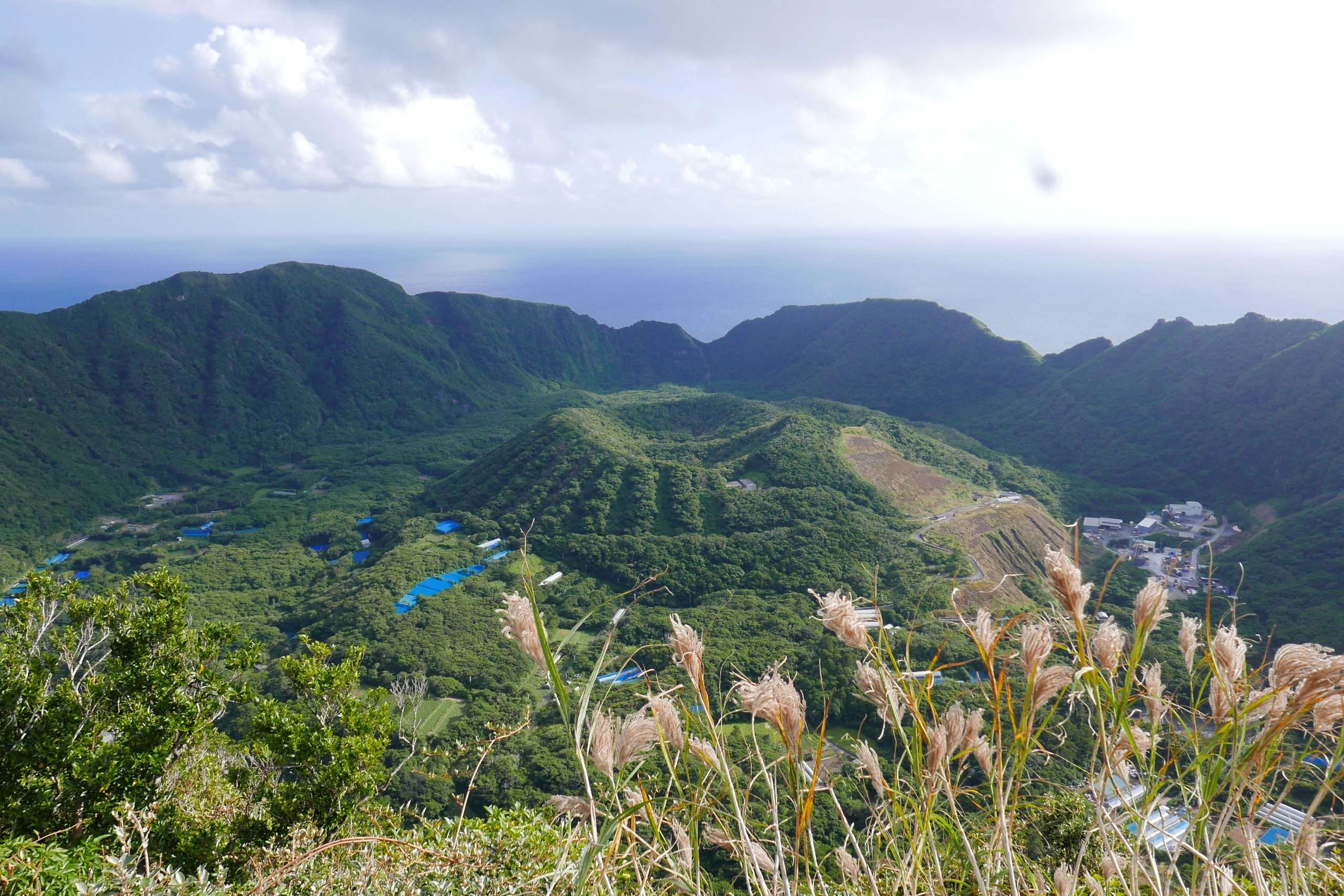
This small island south of Tokyo looks like something a geology textbook illustrator invented for dramatic effect. Reachable only by a small ferry or a short helicopter hop south of Tokyo, Aogashima is a double caldera: an outer crater wall rings the coastline in sheer cliffs, and inside that bowl sits a second, smaller cone rising from the crater floor.
About 170 people live on the outer rim, making it the least populous village in Japan. The island’s current shape dates to an 18th-century eruption that killed roughly half the population and left it uninhabited for decades.
Today, geothermal vents are put to cheerful use: residents cook eggs and sweet potatoes in the steam and soak at a volcano-heated public sauna.
Type: A stratovolcano built from at least four older, overlapping volcanoes whose summit collapsed into a caldera, with a younger cone growing up inside that bowl.
Rarity: Very high. Double calderas with an active inner cone are uncommon worldwide, and one with a permanent human settlement inside it is rarer still.
Activity level: Low. The Japan Meteorological Agency ranks Aogashima Class C, its lowest hazard tier, with no eruption since the 18th century.
Signature feature: A geothermal sauna and communal cooking vents powered directly by the volcano.
2. Mount Aso: A Supervolcano Caldera With an Active Peak Still Smoking at Its Center
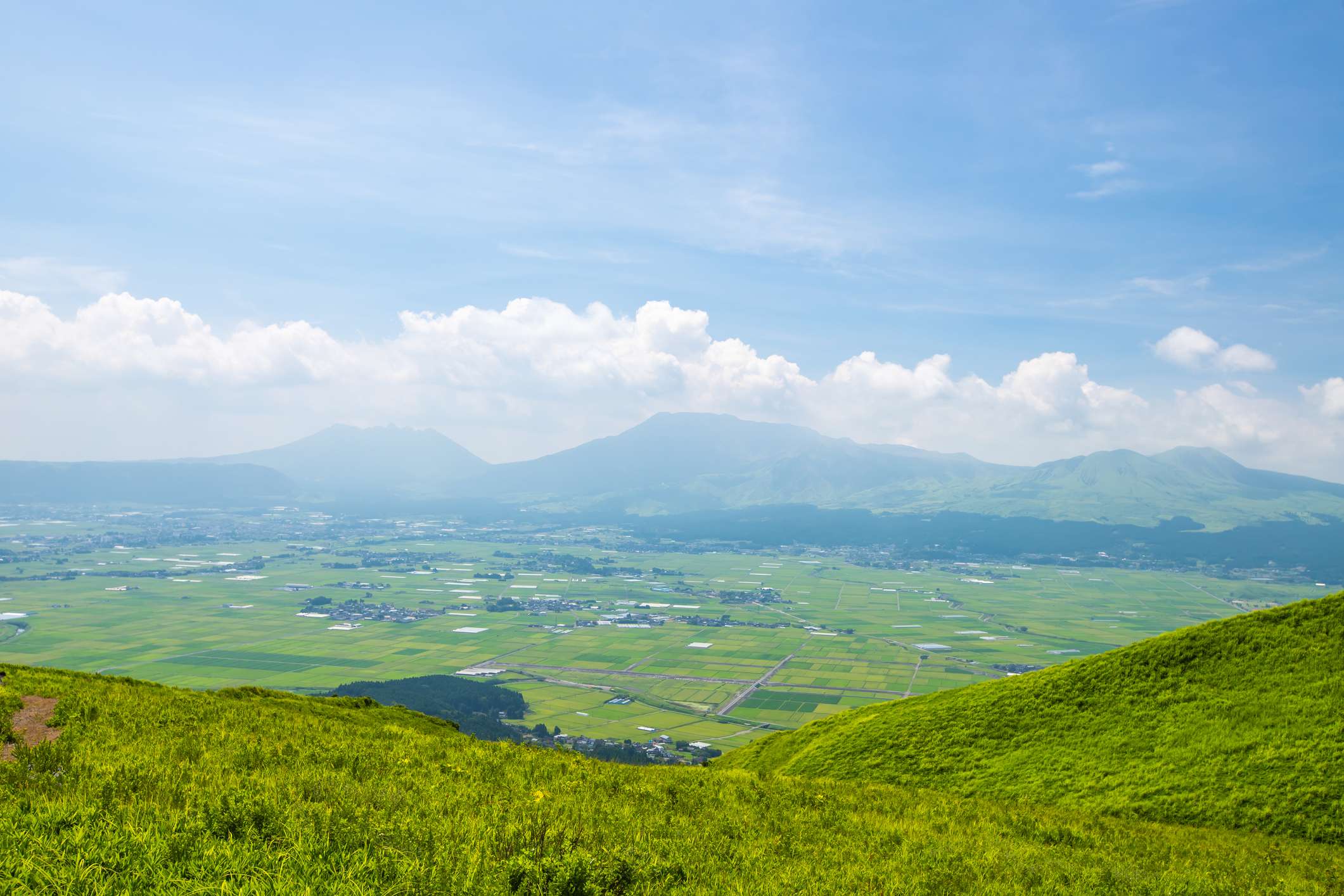
Mount Aso, in Kumamoto Prefecture, is not really one mountain but a caldera roughly 25 kilometers across, formed by a series of enormous eruptions tens of thousands of years ago.
Within it sit five peaks, and one, Nakadake, is still active, its milky green crater lake fuming even on quiet days.
What makes Aso unusual is not just its size, among the largest calderas on Earth, but what’s been built inside it: farmland, train lines, highways and a city of some 50,000 people farming soil made fertile by millennia of volcanic ash.
Type: A caldera with a cluster of younger stratovolcano peaks, Nakadake among them, that grew up inside the basin after the original collapse and remain active today.
Rarity: High. Few calderas this size anywhere in the world contain a functioning city.
Activity level: High. Nakadake has erupted repeatedly in recorded history, including as recently as 2021, and access to the crater rim is periodically closed due to toxic gas.
Signature feature: A crater lake that shifts color with mineral content and gas activity.
3. Sakurajima: The Island That Became a Peninsula
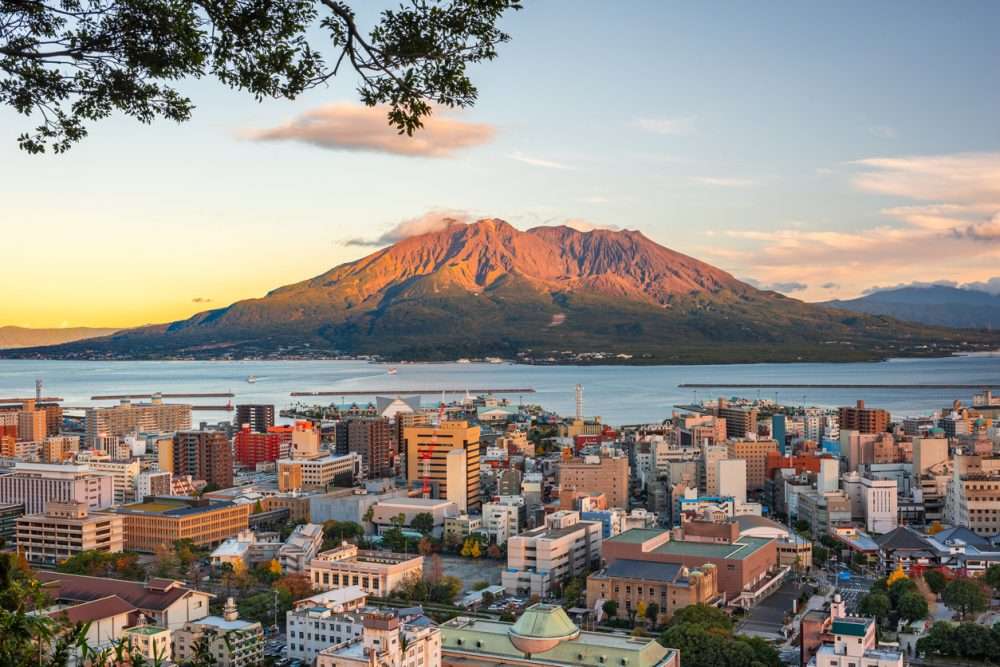
Sakurajima, in Kagoshima Bay, was genuinely an island until a massive 1914 eruption sent lava pouring into the strait and welded it to the mainland. A shrine gate near the coast still stands, buried to its crossbar in ash from that event, left in place as a monument.
Kagoshima City, home to more than 600,000 people, sits just across the bay and has built ashfall forecasts into its regular weather reports.
Type: A classic stratovolcano, rising from the edge of the much older Aira caldera, itself formed by a massive eruption around 29,000 years ago.
Rarity: Moderate as a volcano type, but the 1914 land bridge event is a rare, well-documented case of an eruption redrawing a coastline within living memory.
Activity level: Extremely high. Hundreds of small eruptions occur most years.
Signature feature: Daily ashfall forecasts, alongside the buried torii gate as a physical record of the 1914 eruption.
4. Mount Omuro: The Inverted Rice Bowl With an Archery Range in Its Crater
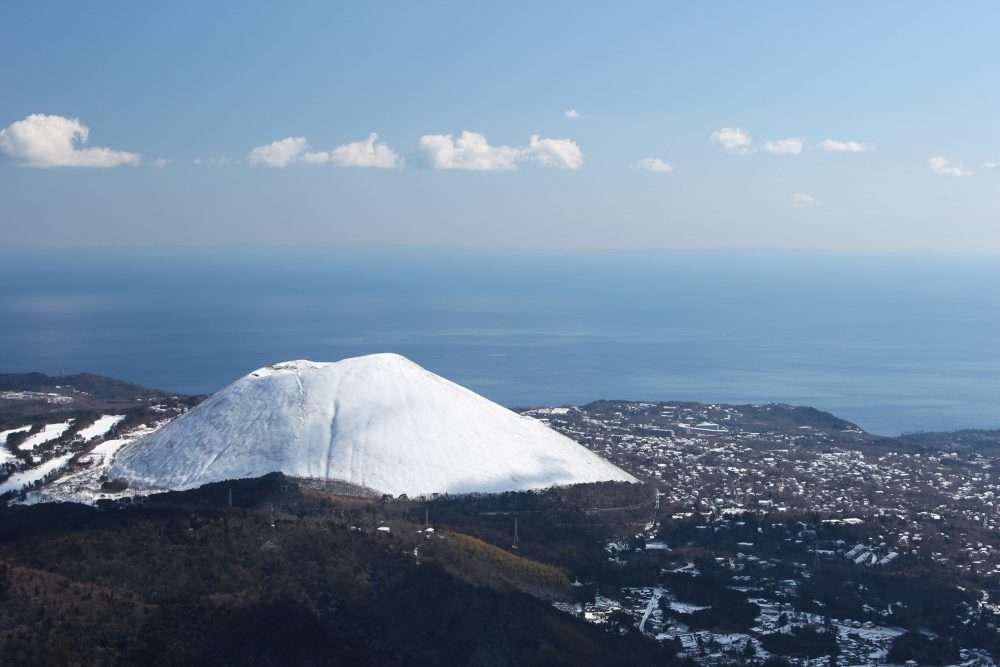
On the Izu Peninsula, Mount Omuro is a scoria cone that formed in a single eruptive burst about 4,000 years ago, leaving a strikingly symmetrical, grass-covered dome locals compare to an upturned rice bowl.
That stability is exactly why the wide crater at its summit has been repurposed as a public archery range. Visitors ride a chairlift to the rim, then descend into the crater floor to shoot arrows across what used to be the volcano’s throat.
Type: A scoria cone, the simplest volcano type there is, built in one go rather than layered up over centuries.
Rarity: Moderate. Symmetrical scoria cones exist worldwide, but few host a public archery facility in the crater itself.
Activity level: Dormant. Omuro’s single eruptive episode ended millennia ago, and the surrounding Izu volcanic field is monitored but currently quiet.
Signature feature: The archery range built into the crater floor.
5. Mount Osore: The Caldera Japanese Mythology Calls the Gateway to the Underworld
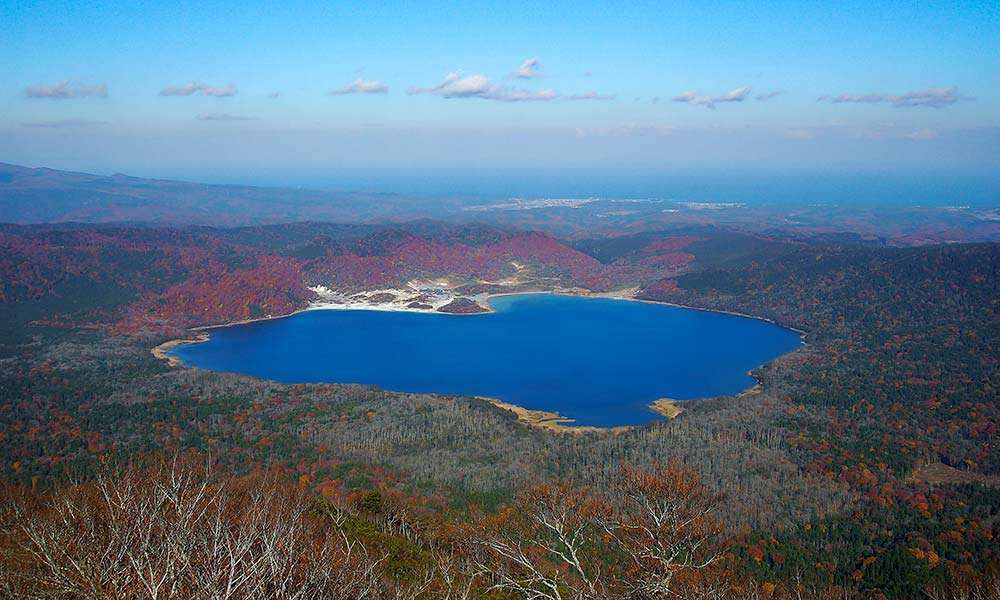
In a remote stretch of Aomori Prefecture, Mount Osore (“Fear Mountain”) is a caldera whose barren, sulfur-streaked terrain has made it one of Japan’s three most sacred sites for over a millennium. Steam vents locals call “hells” hiss along the approach to Bodaiji Temple, founded in the ninth century.
At its center lies Lake Usori, a striking blue-green, sulfur-fed lake so acidic that only a single fish species has adapted to survive there; swimming is prohibited, and the nearby shoreline is known, in deliberate contrast, as Paradise Beach.
Type: A stratovolcano with its own caldera at the summit, ringed by the worn-down remains of older volcanic peaks.
Rarity: High. Acidic caldera lakes tied to an active pilgrimage site and centuries of religious tradition are unusual anywhere in the world.
Activity level: Low to moderate. Osore’s last eruption is estimated at roughly 10,000 years ago, though sulfurous gas continues to vent from the crater.
Signature feature: Lake Usori, whose acidity supports almost no life.
6. Mount Oyama: The Volcano That Turned an Island Into Gas Mask Territory
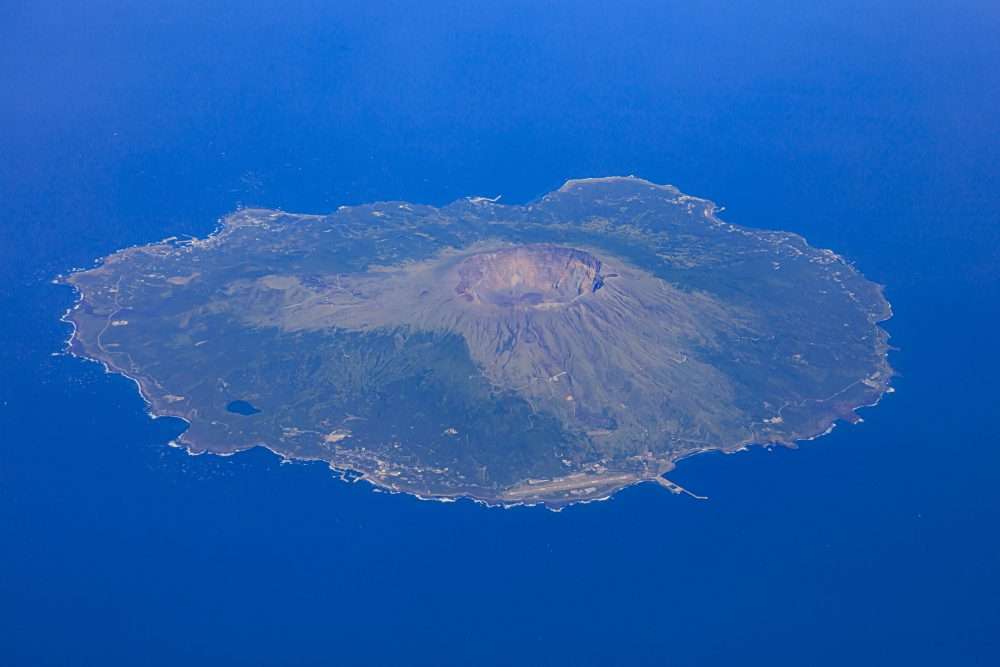
Miyakejima, an Izu island south of Tokyo, earned the nickname “Gas Mask Island” after a 2000 eruption of its central volcano released such heavy sulfur dioxide that authorities evacuated the entire population.
The island stayed off-limits for more than four years. Residents were allowed back in 2005, but the volcano was still venting, so gas masks became mandatory equipment for anyone on the island.
Type: A stratovolcano with two nested calderas stacked at its summit like rings in a tree stump, the inner and smaller one carved out during the dramatic 2000 collapse.
Rarity: Extremely high. A modern, developed community living under a mandatory gas mask policy is essentially unique to Miyakejima.
Activity level: High, chemically speaking. Oyama’s lava output has slowed since 2000, but its gas emissions remain a persistent hazard.
Signature feature: The island-wide siren network that triggers mandatory mask use.
Read more about Japan’s natural wonders:
Endemic Species That Only Exist on Specific Japanese Islands