June 18, 2025
Tokyo’s Underground Temple: G-Cans
A cathedral-like feat of concrete ingenuity
By Tamatha Roman and Jessie Carbutt
This article was originally published in the Spring 2025 Issue of Metropolis Magazine: “Designing the City.” Read the full issue here.
The Underground Temple: Tokyo’s Hidden Flood Fortress
Hidden beneath the suburban landscape of Kasukabe, Saitama Prefecture, lies one of Japan’s most impressive engineering feats—the “Underground Temple.” Its official, less magical name, the Metropolitan Area Outer Underground Discharge Channel (or G-Cans Project), was built to safeguard Tokyo and its surrounding areas from devastating floods.
The colossal structure is both a technological marvel and an unlikely tourist destination thanks to its scale and almost mythic design. It’s a must-see for anyone intrigued by architecture, urban planning or the sheer ingenuity behind keeping a city safe.
At first glance, it might sound more like a science fiction set than a real location. But the G-Cans Project is a flood mitigation system on a scale that few other countries could rival. Completed in 2006 after nearly 14 years of construction and ¥230 billion invested, the system’s purpose is to prevent flooding in Tokyo’s low-lying areas, particularly during typhoons and heavy rainfall.
Through 2014, it successfully adjusted floods and reduced devastation 85 times. To illustrate, in August 2008, when the highest ever inflow was recorded, G-Cans displaced 11.72 million cubic meters of flood water that otherwise would have affected the local community.
How Japan Built the World’s Largest Flood Control System
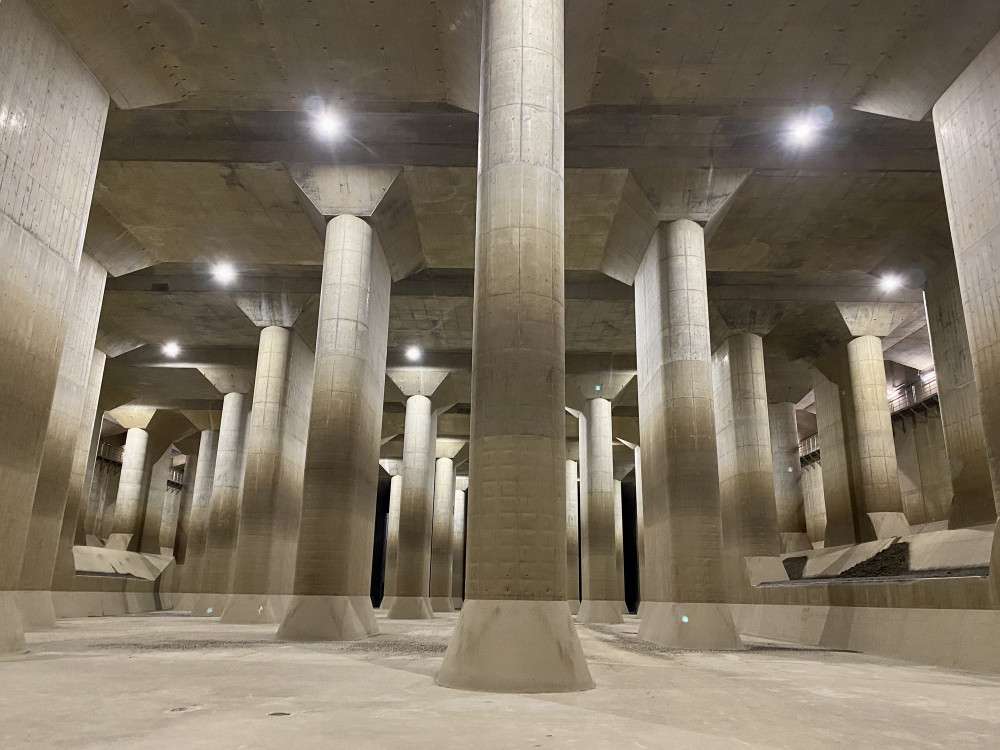
At its core is a 177-meter-long pressure-adjusting water tank, dubbed the “Underground Temple” for its resemblance to a grand cathedral. Its towering 18-meter-high pillars, each weighing an astonishing 500 tons, and cavernous spaces create an almost spiritual atmosphere. The size and symmetry make it feel more like a sacred space than an industrial one. Though its purpose is entirely practical.
In order to function, G-Cans is comprised of a well-oiled system of parts. Five banks, each large enough to accommodate a space shuttle, dot the area, taking in flood water from the aforementioned rivers. They are all interconnected by a 6.3-kilometer tunnel built 50 meters below ground. The tunnel itself, with help from 76 pumps, has the capability to drain flood waters at a speed of up to 200 cubic meters per second—equivalent to a full 25-meter swimming pool. Finally, a water cistern reduces the overflow and drains it smoothly into the Edo River. It’s this cistern, with its 59 stabilizing pillars, all towering 18 meters high and weighing an unfathomable 500 tons, that visitors can gawk at, as included on the tour, available when the facility is not performing its critical function.
When heavy rain threatens Tokyo, water from overflowing rivers is diverted into the system’s vertical shafts, where gravity does most of the work. Once inside, the floodwaters travel through the network of tunnels to the pressure tank, which helps balance the flow. Pumps—each the size of a small house—then expel the water into the Edo River, protecting urban areas from inundation.
This carefully orchestrated process can move up to 200 tons of water per second. That’s like draining an Olympic-sized swimming pool in just 12 seconds. Managing such immense volumes of water requires precise coordination, and during peak flood events, a team of around 30 operators works together to ensure everything runs smoothly.
Though the facility’s primary purpose is flood control, its striking design has turned it into an unconventional yet highly sought-after tourist attraction. You must book a guided tour in advance through the official website. These tours are conducted on weekdays only, primarily in Japanese. Though the visuals alone make it a worthwhile experience, even if you don’t understand the language.
Traveling to Japan? Reserve your pocket WiFi, JR passes and more with JRPass.com.

What to Expect on the G-Cans Tour
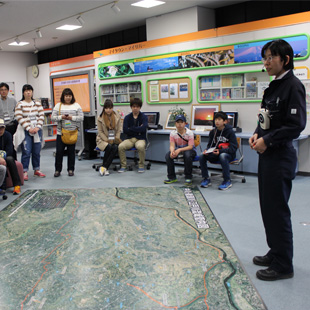
Once down, you are immediately dwarfed. The tour begins with a briefing on the project’s history and mechanics. Then visitors descend into the depths of the pressure-adjusting water tank. Standing among the 59 massive columns, with dim light filtering through, you can’t help but feel like you’re in a post-apocalyptic film set—or perhaps the lair of a movie supervillain.
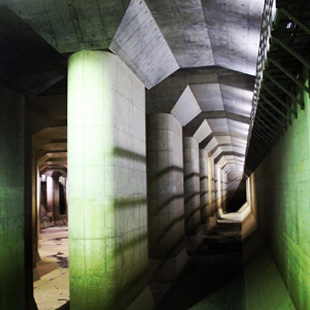
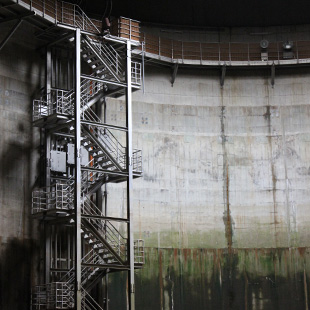
The cistern, with its shadowy and menacing pillars, silently envelops you just like a character in some abandoned world of Final Fantasy. Puddles of water splatter the floor, creating eerie reflections. A drop off at one end of the vault-like room appears to sink into the recesses of hell. Though the tour guide launches into another lecture upon entering the cistern, it can be difficult to concentrate.
Eventually, you have time to wander, albeit only 10 minutes and in a very regulated area that’s sectioned off by rope. Nevertheless, it’s still a worthwhile segment of time with plenty of spectacular photographic potential. Bring along a tripod to combat the low lighting. (Or maybe even a costume for an impromptu modeling session.)
Planning Your Visit to Tokyo’s Underground Temple
Location: Near Minami-Sakurai Station on the Tobu Urban Park Line, about 60–75 minutes from central Tokyo.
Address: 720 Kamikanasaki, Kasukabe, Saitama
Reservations: Required in advance through the official website.
Cost: Approximately ¥3,000 per person.
Tour Availability: Weekdays only, typically between 10 am and 4 pm. Of course, it’s worth noting that the facility occasionally closes during periods of heavy rainfall. Its primary purpose as a flood control system takes precedence.
Website: gaikaku.jp
Interested in how cities are shaped, physically and socially? Explore more here: