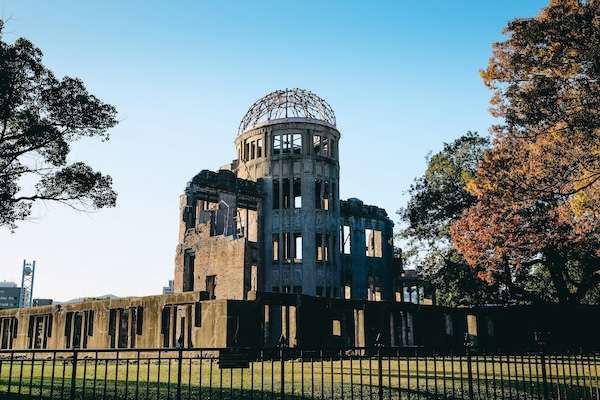
Why Did America Choose to Bomb Hiroshima and Nagasaki?
Remembering Hiroshima and Nagasaki
To Nuke or Not to Nuke, Revisited
In August 2012, Metropolis published “To Nuke or Not to Nuke.” More than a decade later — and now past the 80th anniversary — its argument is worth reading again, not to relitigate the past, but to notice how durable it has proven.
From the original 2012 article:
August 6 will mark the 67th anniversary of the atomic bombing of Hiroshima, and August 9 that of Nagasaki. The gravity of the event is reflected in the continued debate, so long after, about the moral and military justifications of their use.
The piece went on to argue that the bombings, while “dreadful,” were ultimately “the less terrible course of action,” and that the United States had made the right choice:
In a single night of the U.S. bombing, nearly 200,000 people died in Tokyo and, as they had at Okinawa, many more such bombardments would have preceded an American landing. That’s the context in which American commanders decided to use the atomic bomb. Faced with the choice they had, they adopted the less terrible course of action.
Dreadful things happen in times of war, and there are dreadful choices to be made. But these choices can be avoided, and questions of moral legitimacy made irrelevant, by stopping war—or, more precisely, by stopping the people who start wars. The question is, how?
This remains, for many, the global common sense.
In 2026, as August 6 and 9 mark the 81st anniversary, that common sense has if anything become more visible — and more troubling. Last summer, the 80th anniversary was widely described as the last major milestone many survivors would live to witness; the average age of the hibakusha now exceeds 86. In the same season, the logic of the “less terrible course” resurfaced in the present tense: after the United States struck Iran’s nuclear facilities in June 2025, the American president likened the operation to the bombing of Hiroshima and Nagasaki, arguing it had ended a conflict. Survivors in Hiroshima called the comparison unbearable. The argument the 2012 article rehearsed, in other words, is not a settled question about 1945. It is a template still in use.
So it is worth revisiting that argument — not to relitigate history, but to ask how narratives of necessity, isolation, and morality continue to obscure imperial violence.
Lesser Evil?
The most common understanding—to see the positive—is that Hiroshima and Nagasaki, though “terrible,” prevented even greater suffering. It is often said that this greater suffering would have come from a full-scale mainland invasion.
To justify this claim, people often cite grim figures, “nearly 200,000 people” killed in the Tokyo firebombing, “over 250,000” in Okinawa, as examples of what “would have ensued” had the war continued. But here lies a striking contradiction: these casualties were inflicted by the U.S. itself.
The Tokyo firebombing of March 1945, unlike the imagined invasion, actually happened. It deliberately targeted dense residential districts in a campaign designed for maximum devastation. Over 100,000 civilians—many women and children—were killed in a single night. In Okinawa, weeks of relentless U.S. assault killed and displaced civilians alongside Japanese troops. These were not passive tragedies; they were strategic choices.
To cite these very acts of destruction as evidence that “something even worse” was prevented by the atomic bomb collapses into absurdity. The reasoning becomes: because we have already killed hundreds of thousands of civilians, we must kill more—quickly—to stop the killing.
Beyond this moral inconsistency, there’s the question of necessity. Evidence now shows that Japan was already seeking a path to surrender. By July 1945, intercepted diplomatic cables revealed Tokyo’s willingness to negotiate, provided the emperor’s position could be preserved (Frank, Downfall, 1999). The U.S. Strategic Bombing Survey (1946) later concluded that “Japan would have surrendered even if the atomic bombs had not been dropped.”
Historians such as Tsuyoshi Hasegawa (Racing the Enemy, 2005) have demonstrated that it was the Soviet Union’s entry into the war on August 8, not the bombings, that ultimately pushed Japan’s leadership toward capitulation. Far from being a desperate last resort, the bombings reflected geopolitical calculation, signaling to Moscow, asserting postwar dominance in Asia, and fulfilling a military desire to test the new weapon on urban populations. As Gar Alperovitz argued (The Decision to Use the Atomic Bomb, 1995), Hiroshima was as much a demonstration as an act of war.
If the intention were truly to minimize suffering, one might ask: could any official have explained to the hibakusha, the survivors, that their pain represented the “less terrible” choice?
You might also be interested in reading: Does Japan have an army?
The Problem with Tit-for-Tat Morality
Another common thread in English-language discourse is the claim that Japan’s wartime brutality invalidates its victimhood—that because Japan was “horrible,” it cannot “play the victim.”
Such reasoning mirrors a tit-for-tat logic that has no place in ethical or legal frameworks. In law, crimes are prosecuted independently: a person who has committed theft does not lose their right to justice if they are later sexually assaulted. Likewise, a nation’s imperial aggression does not nullify the suffering of its civilians.
By 1945, Japan’s empire was indeed brutal, spanning Korea, Taiwan, Manchuria, and Southeast Asia, but to claim that this made Hiroshima “deserved” is to slide into vengeance, not justice. It also collapses individuals into the abstraction of the state, holding every civilian responsible for the decisions of a militarist elite.
This punitive view also assumes that the U.S. held the moral right to “punish” Japan, a stance that ignores its own imperial record. Japan’s expansionism emerged within an Asia-Pacific already dominated by Western colonial powers: the U.S. in the Philippines and Hawai‘i, Britain in Malaya, France in Indochina, and the Netherlands in Indonesia.
As historian Takashi Fujitani notes (Race for Empire, 2011), Japan’s imperialism was entangled with and modeled upon these Western empires. Recognizing this context does not excuse Japan’s actions, but it challenges the idea that the U.S. stood apart as a liberator rather than a fellow imperial power.
The observation that “Japan was at war with the U.S.” invites a deeper one: whose territories were being defended, and whose were already colonized? Such omissions reveal how the American empire remains unspoken in mainstream narratives, even as Japan’s is continually condemned.
As historian Naoko Wake (2021) writes, “It is easy to condemn a defeated empire; it is harder to confront a victorious one.” Many today feel comfortable criticizing Imperial Japan — precisely because it has fallen — while hesitating to question the violence of U.S. and British empires, which rebranded themselves as moral arbiters in the postwar order.
Assumptions
One assumption behind many articles that “explain” the atomic bombs is that Japan should learn to view the bombings “from the other side”—through an American lens rather than as a “victim.”
The problem is that such arguments often presume how Japan sees itself, without recognizing that Japan’s mainstream understanding has, for decades, not been so different from the U.S. view. In the early postwar years, Japan’s constitution, institutions, and education system were reformed under Allied occupation. As a result, the dominant narrative of the war came to align with U.S. and Western priorities.
This alignment was not purely imposed. It was also strategic, emerging from the early Cold War, when rebuilding Japan as a democratic ally helped establish stability, security, and economic recovery. For many, that arrangement felt both pragmatic and beneficial. The result, however, is that Japan’s mainstream narrative has long echoed early U.S. framings of the war, including the idea that the atomic bombings were justified to end it quickly, with the exception of more overt revisionism on the right.
Only in recent years have more critical perspectives gained space in public discussion, even as that shift can, at times, overlap uncomfortably with the rhetoric of historical revisionists. Thoughtful, critical, and decentralized debate remains vital.
Remembering Hiroshima and Nagasaki
Much has changed in the years since the 2012 article, and much has not. In 2024, Nihon Hidankyo — the confederation of atomic-bomb survivors’ organizations that has spent nearly seven decades insisting that these weapons must never be used again — received the Nobel Peace Prize. The recognition arrived precisely as the taboo it helped build has come under strain: arsenals are being modernized, deterrence is once again spoken of as prudent statecraft, and, as the president’s remark about Iran showed, the framing of nuclear violence as a regrettable necessity is still ready to hand.
That is the uncomfortable backdrop to the 81st anniversary. The witnesses are leaving us. Within a decade or two there may be no one left who can say, in the first person, what that morning was. What remains is the story we choose to tell about it — and the 2012 argument that the bombings were “the less terrible course,” is still one of the most powerful stories on offer, because it lets the decision to use the weapon stand as tragic wisdom rather than choice.
To revisit Hiroshima and Nagasaki today is not to excuse past wrongs, but to examine how narratives of “necessity” and “lesser evil” have shaped our moral imagination. The bombings were not inevitable; they were decisions made within a global system of empire, fear, and technological ambition — and the same grammar of justification is applied to new targets now.
Remembering Hiroshima asks us to look beyond victors and vanquished, to hold space for the grief on all sides, and to question the stories we inherit about what violence is “justified.”
Over eighty years later, perhaps the most powerful act of remembrance is not to debate whether the bomb was right or wrong, but to keep asking why so many still reach for such choices—and whose lives are counted when they do.
You might also be interested in reading: Hiroshima: City of Hope