November 26, 2025
The Fascinating History Behind Japanese Kissaten
Plus top kissaten cafes to visit in Tokyo
It’s easy to forget the humble kissaten. Yet these old-school coffeehouses were once the heartbeat of Japanese café culture. Their legacy still lingers in the deep aroma of siphon-brewed coffee and the comforting crunch of thick-cut buttered toast.
Kissaten (喫茶店), which translates to “tea-drinking shop,” is more than just a place to get a drink. It is a cultural archive. To step into a kissaten is to enter a parallel Japan: dimly lit, wood-paneled, vinyl-spun and quietly unbothered by the demands of the modern world.
A Birthplace of Ideas: Kissaten in the Taisho and Early Showa Periods
The kissaten we know today emerged during the Taisho period (1912–1926), an era marked by liberalism, artistic exploration, and new waves of Western influence. Early establishments were modeled after Viennese and Parisian salons, serving as spaces where writers, poets, and thinkers gathered, often reading newspapers for hours, or debating political ideology over endless cups of coffee.
As early as the 1870s, coffee was already being served in pioneering establishments. For example, Hokodo in Kobe opened in 1874, and is remarkably still in business today. Yet coffee remained a curiosity, an expensive import that had little chance of displacing Japan’s thousand-year-old tea culture.
This mirrored a broader global history. Tea from East Asia and coffee from West Asia had both entered European high society in the 17th and 18th centuries as exotic luxuries. In Japan, however, tea was already deeply rooted, while coffee, first recorded in Nagasaki in the late 1700s, took more than a century to gain traction in everyday establishments.
A more formal experiment arrived in 1888 with the opening of 可否茶館 (Kahiichakan or Kohisakan) in Ueno, often cited as Japan’s first modern-style coffee house. Founded by Tei Eikei (鄭永慶), the establishment was conceived as a cultural and intellectual salon, offering not only coffee but also books, writing materials, and space for conversation and leisure. It was much like the European coffeehouses that inspired it. Yet the café proved too far ahead of its time. With coffee still expensive and café culture not yet rooted among the general public, the business closed within just a few years.
Still, the template had been set. Over the next few decades, more accessible kissaten began to appear in Tokyo and Osaka. Unlike the more glamorous kafe of the same era, which were often associated with showgirls and musical performances, kissaten positioned themselves as respectable and restrained. They were introspective spaces. Quiet, sometimes smoky. A place where a writer might nurse a single drink while drafting the next chapter of a novel.
(And if you’re looking for something to read, we recommend you read our guide to the best Japanese mystery novels.)
This division of café types, intellectual versus entertainment, reflected broader tensions in Japan’s modernizing identity. And the kissaten, understated but sturdy, would go on to define an entire century of Japanese social life.
Check out our cafe page for more cafe inspiration around the city.

The Golden Age: Postwar Comfort and Reinvention
The post-World War II years were perhaps the kissaten’s golden age. As Japan began its rapid economic recovery, kissaten spread across cities and regional towns alike. Often family-run, they became neighborhood institutions, functioning as informal community centers where customers were known by name.
For many urban folks, the kissaten offered an essential third space, neither home nor work, where one could linger for hours with no pressure to order more than a single coffee. And unlike the grab-and-go culture of contemporary cafés, kissaten emphasized staying. The service was quiet but attentive, the atmosphere deliberately designed to make time slow down. It evokes a somewhat similar atmosphere to the history of sento.
This era also saw the rise of the now-iconic morning set (モーニングセット), which is a breakfast special that typically includes toast (often an inch thick), a boiled or fried egg, a small salad, and a hot drink. In Nagoya, cafés began an arms race to offer the most elaborate morning service. In some cafés, the cost of a single coffee covered an entire meal, complete with miso soup, spaghetti, or even fried chicken.
In Tokyo, some kissaten began to specialize in handmade desserts, like rare cheesecakes or flan-like purin, served in silver bowls that looked like they had been around since the Showa 40s (the 1960s).
Atmosphere Over Efficiency: The Aesthetics of Resistance
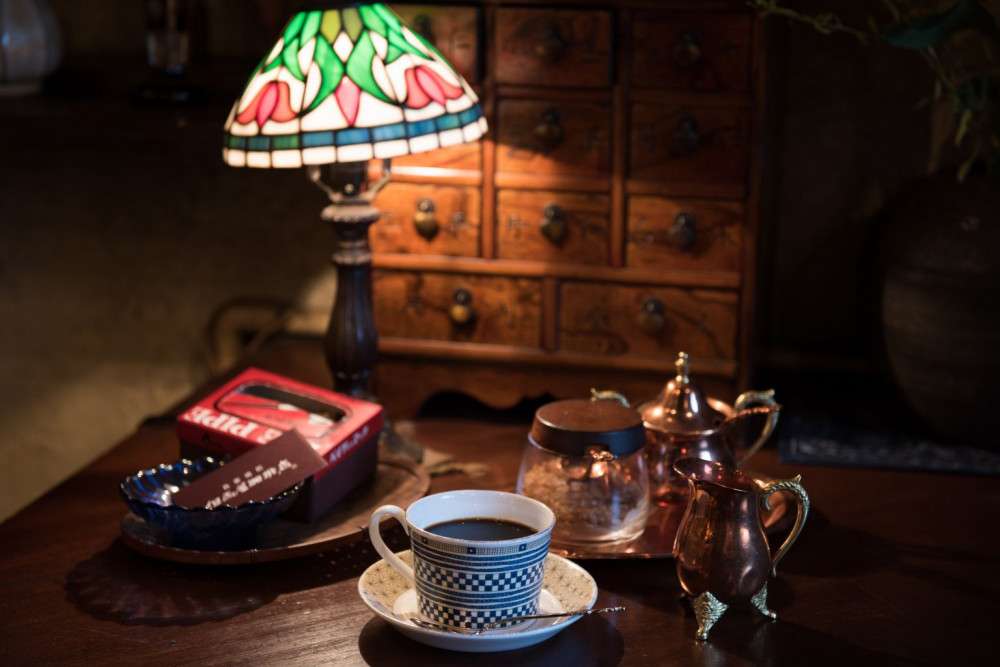
A kissaten’s atmosphere is as important as its menu. Walk into one, and you’re likely to find:
- Smoky air tinged with nostalgia and old furniture polish
- Wooden booths or leather armchairs with just the right level of wear
- Classical or jazz music drifting softly from speakers—often played on vinyl
- Newspapers hung over wooden rods
- A counter lined with glass siphon coffee makers gleaming under dim light
The meticulous coffee preparation, often using hand-pulled pour-overs or siphon brewers, can feel more like a ritual than a routine. Although siphon brewing originated in 19th-century Germany, it gained popularity in Japan for producing clean, complex flavors.

A Space for All: Gender and Solitude
In the early 20th century, kissaten provided one of the few public places where women could gather without being associated with nightlife or hostess entertainment work. It was considered a “more respectable” and neutral alternative to bars, ochaya (teahouses) and kissas (jazz cafes). They became normalized spaces where women could study, meet friends or sit alone in peace.
Surviving the Modern Café Boom
By the late 1990s and early 2000s, their popularity began to decline. Chains like Starbucks, Tully’s and Doutor dominated Japan’s café landscape with their bright lighting, modern design and fast service.
Many kissaten shuttered as their aging owners retired, and younger generations hesitated to take over. The economics didn’t help either—kissaten operated on low margins and long opening hours, often relying on a shrinking group of loyal locals.
And yet, they’ve never entirely disappeared. In fact, the last few years have brought a quiet revival.
A Slow Renaissance
Today, a new generation is rediscovering kissaten—not just as retro novelties, but as essential antidotes to digital burnout and fast-paced urban life. New cafés have begun borrowing their look and feel: faux wood paneling, analog menus, and vintage dishware.
Still, the real Japanese kissaten experience can’t be duplicated. It must be felt. The scent of aged wood, the clink of ceramic cups, the stillness. The refusal to rush. As such, I would recommend you visit these authentic classic Kissaten in our Guide to Kissaten in Tokyo.
You might also be interested in A Short History of the Japanese Cheesecake.